

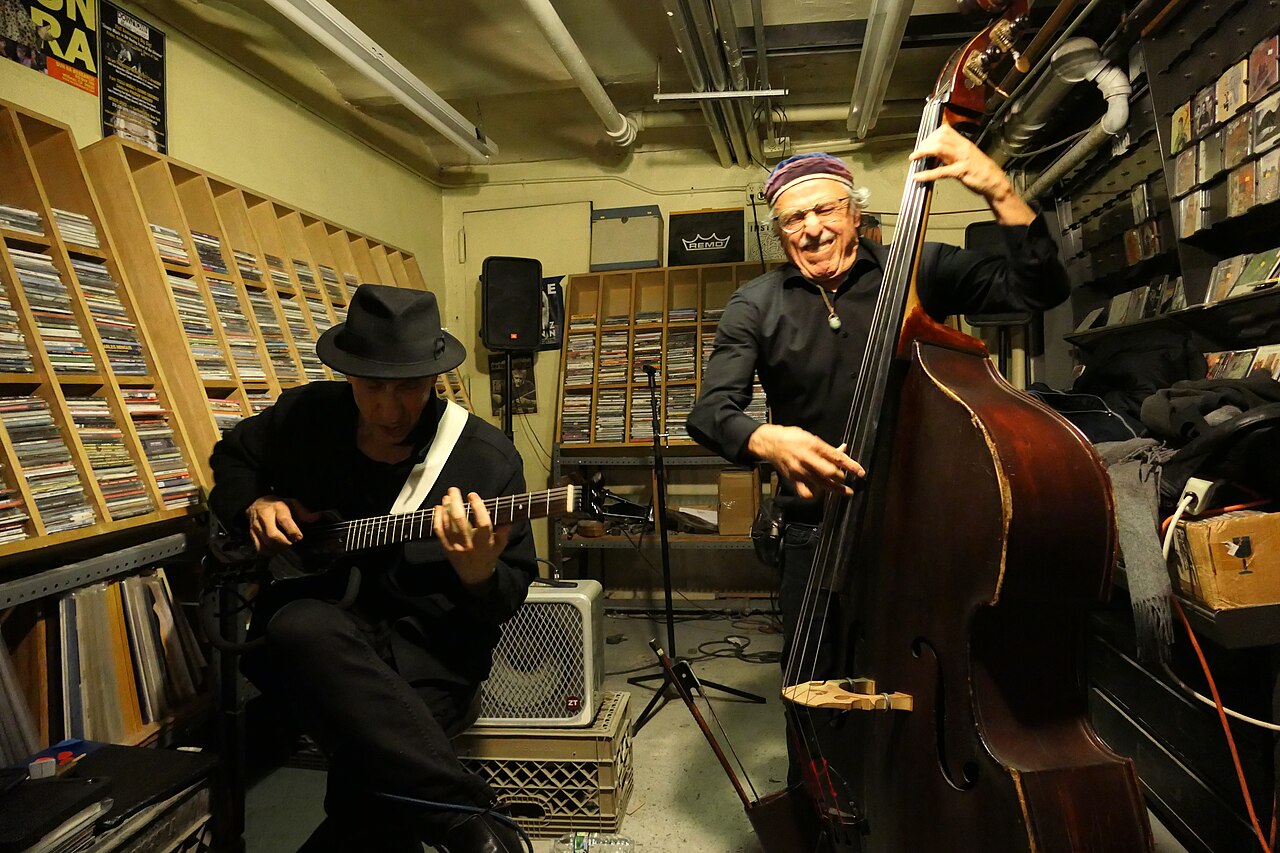
Sunday, January 12, 2025
Image: Alex Lozupone (Wikimedia Commons).
On January 12, Downtown Music Gallery hosted a rare Monday night reading. Known for its weekly free concert series, this reporter observed that attendance was high for this atypical event.
Elliott Sharp read first from his new book, Feedback: Translations from the IrRational, and was then interviewed by Bruce Gallanter. Joe Fonda then discussed passages from his new book, My Life in the World of Music with Gallanter. After these talks, Sharp and Fonda, who have known each other since 1978, performed together for the first time, as a duo, both using a variety of extended techniques. Sharp played electric guitar his electroacoustic guitar through an amplifier, while Fonda played acoustic contrabass with no amplification.
Gallanter: Elliott, I have a few questions for you.
Sharp: Okay, if we have time.
Gallanter: Yeah. When did you pick up the guitar?
Sharp: 1968.
Gallanter: And you would listen to mostly rock music at that point?
Sharp: Yeah, and classical music. I played classical piano as a kid
and classical clarinet after that when I was eight, when the piano gave me
asthma (in my interpretation) that nearly killed me. So I played clarinet,
then I got an electric guitar, and that was it. The clarinet went by the
wayside. Also, I got kicked out of wind ensemble and marching band because
I came back from a summer residency after my junior year with long hair
and a beard, and Al Renino, the band director, would have none of that.
Gallanter: When you first started playing, were you playing kind of blues rock stuff at the beginning?
Sharp: Well, making psychedelic noise, I was very inspired by readings
I was doing in Cage, I was an electronics geek, so I was building my
own circuits and experimenting with tape delays and building ring modulators
and fuzz, so I was making a lot of noise… and trying to learn Jeff
Beck’s guitar playing from the Yardbirds records and then Jimi Hendrix. I
mean, Jeff Beck’s playing, at least I could find the notes. With Hendrix, it was
beyond me at first, it was just so sonic, you know, but yeah, and a lot of
blues, country blues, playing a lot of slide.
Gallanter: So you played in blues rock bands?
Sharp: Yeah. I was playing, the first blues band I was in was called the MFBB, the MotherFucking Blues Band, and I was playing bass in that.
Gallanter: And that was 68, 69?
Sharp: That was 68, 69 when I was still in high school. I started playing guitar and bands and pedal steel in Ithaca in 1970 when I was at Cornell.
Gallanter: OK. That’s where you went to school first?
Sharp: Yeah.
Gallanter: So you’ve had I mean, I know that most people think of you more as avant-garde kind of noisemaker, even with the guitar and the other instruments that you play, but it seems that you’ve always had that blues thing.
Sharp: Yeah, blues. And I went for a long period of playing bebop and starting with Roswell Rudd. But I’ll still do gigs occasionally, playing like for a party, playing some blues or jazz or funk tunes, and people come and say, well, I didn’t know you actually knew how to play guitar.
Gallanter: Somebody said the same thing today when we had on that Terraplane CD. They said, this is Elliott Sharp? He plays the blues? I said, he plays the blues really well, and he’s obviously studied it, because you’ve been doing records of that, starting with that Hoosegow record.
Sharp: Right. Well, even going back for that playing in bands that never recorded, but the first Terraplane record was in 1994. And also, I mean, Just living with that music and going to hear as much of it live as I could. And then working with Hubert Sumlin from 1994 until he passed away.
Gallanter: Hubert Summon played guitar for..
Sharp: Howling Wolf and a little bit with Muddy Waters, but without Hubert; Hubert’s DNA is throughout American electric blues playing. Without Hubert, there would have been no Jimi Hendrix, no Eric Clapton, no Robbie Robertson, and Jeff Beck, Jimmy Page. And his playing is throughout. Hubert was what’s called by his former manager, the Picasso of the blues, because he took a very Cubist approach. Hubert was very spontaneous. And I mean, his playing was very unpredictable and very vocal. And he’d just interject weird little noises and pops and slides and bangs and screams and laughs. I mean, really, he could do anything. And as I said, I worked with Hubert for many years and standing this far away from him. We took Hubert on tour to Europe a number of times in England and watching his right hand, and I still have no idea how he played what he played. He had an incredibly relaxed right hand use- no pick – so it was mostly the left-handed. Yet he would have this amazing articulation there, and Hubert was a master. Supernatural.
Gallanter: Tell me about meeting Jimi Hendrix.
Sharp: Sure. Well, I was in Manny’s Music in July of 1969.
Gallanter: This is a famous music store where you buy equipment, and there was like a whole row of these stores.
Sharp: And there was, yeah, music row on 48th. And there was a wall of pictures of famous musicians who bought their stuff there. So I’m sitting there trying out the cheapest Gibson guitar they had. And I’m just, you know, as I said, I was doing a lot of noise, but I really didn’t have a lot of regular chops on guitar. So I was playing the three chords to Gloria(wikilink?), and I see standing in front of me gold boots and turquoise pants, and I look up, and it’s Jimi Hendrix smiling down at me. So I put the guitar down, and I went, oh, hi. And he was very kind, very sweet guy, you could tell. And he went, oh, hi. And then he was trying out fuzzboxes. So I had like a private concert of Jimi Hendrix trying out fuzzboxes for 40 minutes. Mind-blowing. And he played it on, was it Dick Cavett? Yeah, Dick Cavett that night playing. And he was playing with the two guys from the house band backing him up.
Gallanter: (Ed Shaughnessy..?)
Sharp: Ed Shaughnessy on drums. This kind of chubby session guy wearing an Apache scarf, you know. But they played okay. They played great. I think he played Hear My Train A Comin’, and a very funny interview with, with Cavett. I mean, you could see he was a very humble guy. Cavett said, well, people say you’re one of the world’s greatest guitar players. He said ‘no, no, no man…’
Gallanter: He was much more humble than people thought.
Over the past, I don’t know, maybe 10 years, a large number of musicians that I know have been putting up books.
Sharp: Yeah. It’s just an old saying. Young people do things. Old people write books. I don’t know who said that. I’ve tried to find who said that first.
Gallanter: There’s some truth in that. And I get these books, I read them all. And I learned a lot. A lot of them have good interviews with other people. And Elliot put out a book in 2018, which was more autobiographical. He just sold out of copies. And he put out a book this year called Feedback. And that book is kind of him digging into the different ideas that he had in the other book and on those ideas. And I find this book fascinating because he talks about all the different types of music that he’s been involved with and concepts of music and the way music affects people. And I just read a couple of pages at a time and think about what he says and think about how his concept applies to my understanding of music. So we have some copies on the counter. Elliot will sign them if you’d like. We don’t have any copies of the first one, but he’s going to get more made.
Sharp: It’s out of print, actually. It went through two printings, which I’m really happy about. And what the publisher, which is Terranova Press, run by David Rothenberg, who you may know as a composer and clarinetist and author, he’s going to start doing print-on-demand. So that will be available again.
Gallanter: So Joe Fonda also wrote a book about his life that came out recently. And I just want to say that I met Elliot in 1980 in New York. That was kind of, for me, the beginning of the downtown scene, because within about three years between 79 and 81, I met John Zorn, Eugene Chadborn, Pauli Bradfield, Wayne Horvitz, Robin Holcomb, Tom Cora,. All those people I didn’t know, and we all became friends, and I watched them all develop and evolve in all kinds of ways. First time I saw Elliott play, he was playing tenor sax in a trio, at the performing garage, maybe?
Sharp: Yeah. The Trio In Transit with Steve Piccolo, the original bass player in The Lounge Lizards, is an old and dear friend of mine from the university days, and the great Denis Charles on drums, who was really one of my favorite drummers, favorite people. I couldn’t believe it when I moved to where I was living, I was introduced to Denis, who lived across the street, so we got to hang all the time, and Denis of course, played with my former teacher, Roswell Rudd. There’s a great record called School Days of Roswell and Steve Lacey, and, who’s the bass player on that?
Gallanter: Henry Grimes.
Gallanter: So I know this guy almost as long. I’ve seen him in a lot of different bands, Joe Fonda. I like his book because it’s really about his life. And a lot of these books, I get to learn people’s stories. And everybody has a different story. And we kind of learn about how they came up and what kind of molded them. You played electric bass in the early days?
Fonda: Yeah.
Gallanter: When you started out?
Fonda: Yeah, sure. I didn’t even know there was such a thing as an upright bass as a teenager.
— Fonda interview forthcoming —


