
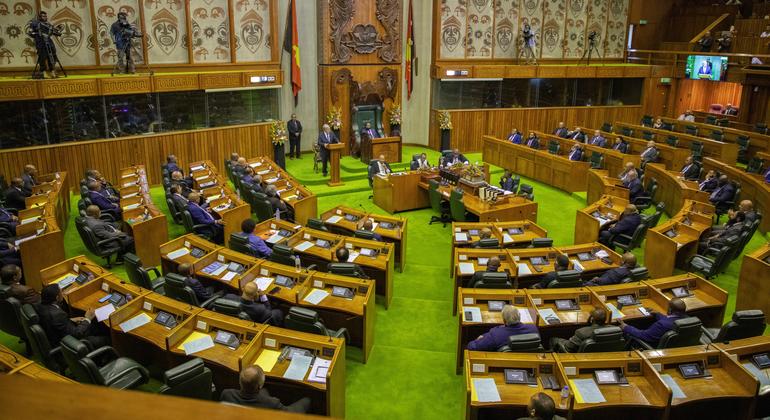
Head of the IPU, Martin Chungong, told a UN conference in New York on Wednesday that “if the phenomenon goes uncontrolled, there will be major implications for democracies, parliaments and human rights worldwide”.
In an interview with UN News, Valentina Grippo, an Italian MP with the European Delegation to the IPU – which partners with the UN – emphasised the difficulties MP’s have just doing their job today: “If you say something that is not perfectly in line with what your audience wants to hear, then you have multiple attacks.”
The report titled When the public turns hostile: Political violence against parliamentarians, includes responses from parliamentarians across 85 countries, with in-depth case studies in Argentina, Benin, Italy, Malaysia and the Netherlands to reflect diverse political and regional contexts.
Key Findings
- Violence is heavily concentrated online with between 65 and 77 percent of MPs across the five-case studies report experiencing abuse online.
- Most common forms of intimidation:
– Insults and degrading language
– Spread of false or misleading information
– Direct threats - A majority of respondents say the situation is worsening. In Argentina and the Netherlands, eight out of 10 MPs report an increase in violence over the past five years.
- Online violence frequently increases around:
– National or local elections
– High-profile legislative debates
– Polarizing political or cultural issues - Gender gap:
– 76 per cent of women MPs report exposure to violence
– 68 per cent of men MPs report exposure - Gender-based abuse: Women are disproportionately targeted with gendered and sexualized violence, particularly online.
- Impact of emerging technologies: Abuse is increasingly amplified by AI-generated content and deepfakes.
- MPs from minority or disadvantaged groups, including racial minorities, people with disabilities, and LGBTQIA+ communities, face heightened levels of online violence.
Why the increase?
The IPU report highlights several factors driving the increase in public hostility, including rising political polarization, economic and social pressures that contribute to public frustration, the amplification of anger through social media, and declining trust in public institutions
Ms Grippo emphasised that “you no more have the confrontation between ideas, which is normal, which is part of politics, but you really have a fight between identities.”
Who is committing the violence?
Violence against Members of Parliament is most often carried out by individuals rather than organised groups.
Online, anonymous users are identified as the main perpetrators by nearly nine in 10 MPs in Argentina, Italy, Malaysia and the Netherlands (89–93 per cent).
“Those we surveyed consistently told us that sustained online abuse affected their offline behaviour including their willingness to engage publicly and their sense of personal safety,” Mr Chungong said.
Impact on democracy
The IPU warns that public intimidation of Members of Parliament can have serious consequences for democracy.
As hostility increases, many MPs report censoring themselves, avoiding certain public appearances, and experiencing negative impacts on their family members.
Some also choose to step down or not seek re-election. Over time, the report warns, these trends can erode democratic representation, discourage diversity, and weaken parliaments as democratic institutions.
“It makes it more difficult to somehow be able to deliver a message without fearing that it is misunderstood.” Ms Gruppo added that “we always have to remember that there are big parts of the world where you cannot say what you think without fearing for your safety.”
The report calls on political and parliamentary leadership to set boundaries when it comes to acceptable public discourse and to ensure that intimidation does not succeed in silencing dissenting and minority voices.
The IPU is the global organization of national parliaments. It was founded in 1889 as the first multilateral political organization in the world, encouraging cooperation and dialogue between all nations.
Today, the IPU comprises 183 national Member Parliaments and 15 regional parliamentary bodies. It promotes peace, democracy and sustainable development.
It helps parliaments become stronger, younger, greener and more gender-balanced. It also defends the human rights of parliamentarians through a dedicated committee made up of MPs from around the world.