

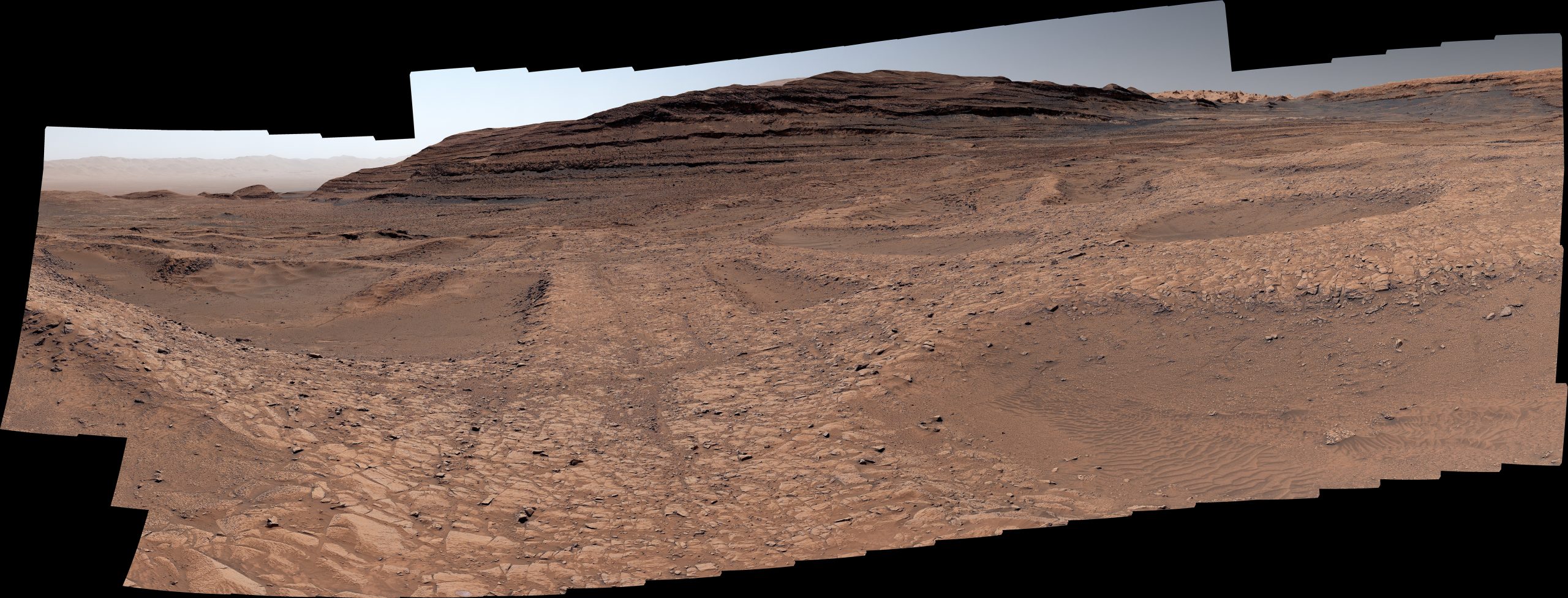
For about six months, NASA’s Curiosity Mars rover has been exploring a region full of geologic formations called boxwork, low ridges standing roughly 3 to 6 feet (1 to 2 meters) tall with sandy hollows in between. Crisscrossing the surface for miles, the formations suggest ancient groundwater flowed on this part of the Red Planet later than scientists expected. This possibility raises new questions about how long microbial life could have survived on Mars billions of years ago, before rivers and lakes dried up and left a freezing desert world behind.
The boxwork formations look like giant spiderwebs when viewed from space. To explain the shapes, scientists have proposed that groundwater once flowed through large fractures in the bedrock, leaving behind minerals. Those minerals then strengthened the areas that became ridges while other portions without mineral reinforcement were eventually hollowed out by wind.
Until Curiosity arrived at this region, however, no one could be sure what these formations looked like up close, and there were even more questions about how they were made.
Although Earth also has boxwork ridges, they’re rarely taller than a few centimeters and are usually found in caves or in dry, sandy environments. The Curiosity team wanted to get a close look at the Martian formations and gather more data. This posed a real challenge for rover drivers: They needed to send instructions to Curiosity, an SUV-size vehicle that weighs nearly a ton (899 kilograms), so that it could roll across the tops of ridges not much wider than the rover itself.
“It almost feels like a highway we can drive on. But then we have to go down into the hollows, where you need to be mindful of Curiosity’s wheels slipping or having trouble turning in the sand,” said operations systems engineer Ashley Stroupe of NASA’s Jet Propulsion Laboratory in Southern California, which built Curiosity and leads the mission. “There’s always a solution. It just takes trying different paths.”
For scientists, the challenge is piecing together how such a vast network of boxwork could exist on Mount Sharp, the 3-mile-tall (5-kilometer-tall) mountain the rover has been ascending. Each layer of the mountain formed in a different era of Mars’ ancient, changing climate. The higher Curiosity goes, the more the landscape bears signs that water was drying out over time, with occasional wet periods that saw the return of rivers and lakes.
“Seeing boxwork this far up the mountain suggests the groundwater table had to be pretty high,” said Tina Seeger of Rice University in Houston, one of the mission scientists leading the boxwork investigation. “And that means the water needed for sustaining life could have lasted much longer than we thought looking from orbit.”
Previous orbital imagery included one crucial piece of evidence: dark lines running across the “spiderwebs.” In 2014, it was proposed that these lines might be what are known as central fractures, where groundwater seeped through rock cracks and allowed minerals to concentrate. Investigating the ridges up close, Curiosity found that these lines are in fact fractures, lending weight to that hypothesis.
The rover also discovered bumpy textures called nodules, an obvious sign of past groundwater that has been spotted many times by Curiosity and other Mars missions. Unexpectedly, these nodules were not found near the central fractures, but along a ridge’s walls and the hollows between them.
“We can’t quite explain yet why the nodules appear where they do,” Seeger said. “Maybe the ridges were cemented by minerals first, and later episodes of groundwater left nodules around them.”
A major part of Curiosity’s science centers on rock samples collected by the rock-pulverizing drill on the end of the rover’s robotic arm. The resulting powder can be trickled into complex science instruments in the vehicle’s body for analysis.
Last year, three samples from the boxwork region — one from a ridgetop, one from bedrock within a hollow, and one from a transitional area before Curiosity reached the ridges — were collected by the drill and analyzed with X-rays and a high-temperature oven. The X-ray analyses found clay minerals in the ridge and carbonate minerals in the hollow, providing additional clues to help understand how these features formed.
The mission recently collected a fourth sample, which was analyzed with a special technique reserved for the most intriguing science targets: After the pulverized rock went into the rover’s high-temperature oven, chemical reagents reacted with the sample to conduct what is called wet chemistry. The resulting reactions make it easier to detect certain organic compounds, carbon-based molecules important to the formation of life.
Sometime in March, Curiosity will leave the boxwork formations behind. The whole region is part of a layer on Mount Sharp enriched in salty minerals called sulfates, which formed as water was drying out on Mars. Curiosity’s team plans to continue exploring this sulfate layer for many miles in the coming year, learning more about how the ancient Red Planet’s climate changed billions of years ago.
Curiosity was built by NASA’s Jet Propulsion Laboratory, which is managed by Caltech in Pasadena, California. JPL leads the mission on behalf of NASA’s Science Mission Directorate in Washington as part of NASA’s Mars Exploration Program portfolio.
To learn more about Curiosity, visit:
science.nasa.gov/mission/msl-curiosity
Andrew Good
Jet Propulsion Laboratory, Pasadena, Calif.
818-393-2433
[email protected]
Karen Fox / Molly Wasser
NASA Headquarters, Washington
240-285-5155 / 240-419-1732
[email protected] / [email protected]
2026-013