
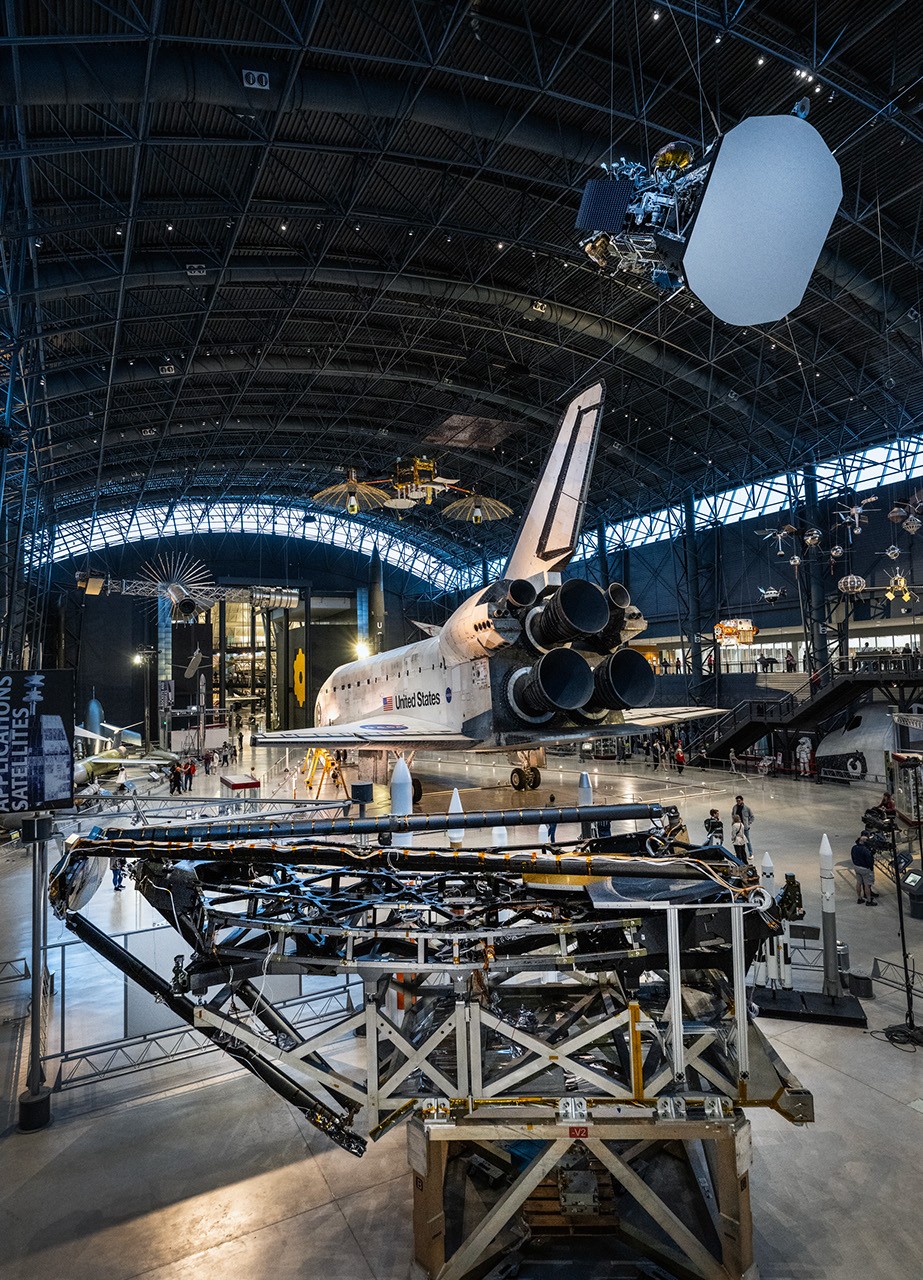
A testing replica of the “backbone” of NASA’s James Webb Space Telescope and a full-scale model of the agency’s Parker Solar Probe are now on permanent display at the Smithsonian’s National Air and Space Museum, Steven F. Udvar-Hazy Center in Chantilly, Virginia.
“From touching the Sun with Parker Solar Probe to creating humanity’s most powerful window into the cosmos with the James Webb Space Telescope, these missions show what humanity can achieve as we continue to push the boundaries of human knowledge through visionary science,” said Nicky Fox, associate administrator, Science Mission Directorate, NASA Headquarters in Washington. “It’s not just the iconic hardware from these NASA missions on display — it’s the courage, skill, and ingenuity of the scientists, engineers, and teams who dared to turn the nearly impossible into reality.”
Webb’s Optical Telescope Element Pathfinder is the largest intact mirror support structure of its kind, standing over 21 feet tall, with a secondary mirror that when fully deployed reaches more than 26 feet. This pathfinder was constructed as a high-fidelity telescope nearly identical to Webb, the largest and most powerful space telescope ever built. Webb’s science goals required an exceptionally precise mirror, too large to fit fully deployed in any available rocket. The mission’s enormous size, complexity, and extreme temperature requirements demanded a comprehensive rethinking of how to test a spacecraft for the rigors of spaceflight. The pathfinder served a key role in surmounting these challenges.
“NASA is proud to see the James Webb Space Telescope Optical Telescope Element Pathfinder on display at the Smithsonian’s Udvar-Hazy Center,” said Mike Davis, NASA’s project manager for the Webb telescope at the agency’s Goddard Space Flight Center in Greenbelt, Maryland. “This remarkable test structure helped engineers prepare the largest space telescope ever built. Standing before it, visitors can glimpse not only the immense scale of Webb, but also the human curiosity and ingenuity that drive us to reach beyond our world and explore the universe.”
Joining the Webb pathfinder on display is a replica of NASA’s Parker Solar Probe. Built and operated at the Johns Hopkins Applied Physics Laboratory (APL) in Laurel, Maryland, Parker is more than seven years into its daring mission, with numerous successful encounters bringing the spacecraft just 3.8 million miles from the solar surface at a blazing 430,000 mph — faster and closer than any spacecraft in history. Despite brutal temperatures and radiation conditions, Parker Solar Probe has completed 27 of these close approaches to collect unprecedented data from the only star we can study up close. The replica allows visitors insight into the innovative technology behind the spacecraft’s ability to survive and successfully sample the Sun’s super-heated outer atmosphere.
Also built at APL, the Parker replica stands 10 feet high, 21.5 feet long, and 8.5 feet wide and includes several of the mission’s spare parts. Several of the components are exact duplicates of the hardware now in space, built to be swapped if flight hardware failed in prelaunch testing. These components include the heat shield that protects the probe from temperatures nearing 2,000 Fahrenheit and a camera called WISPR (the Wide-Field Imager for Solar Probe) that views and records the Sun’s activity just off the surface. The model also includes a copy of the solar array cooling system that circulates water through solar panels to survive the Sun in close approaches.
“Parker Solar Probe has been vital for giving us an up-close look at one of the most extreme environments in our solar system, showing us where space weather is born,” said Adam Szabo, Parker Solar Probe mission scientist at NASA Goddard. “This information is key to understanding the Sun’s upper atmosphere and how it affects us.”
The James Webb Space Telescope is the world’s premier space science observatory. Webb is solving mysteries in our solar system, looking beyond to distant worlds around other stars, and probing the mysterious structures and origins of our universe and our place in it. Webb is an international program led by NASA with its partners, ESA (European Space Agency) and CSA (Canadian Space Agency).
Parker Solar Probe was developed as a part of NASA’s Living With a Star (LWS) program to explore aspects of the Sun-Earth system that directly affect life and society. The LWS program is managed by the agency’s Goddard Space Flight Center in Greenbelt, Maryland, for NASA’s Science Mission Directorate in Washington. Johns Hopkins APL manages Parker Solar Probe for NASA and designed, built, and operates the mission.
To learn more about NASA’s science missions, visit:
By Thaddeus Cesari, Desiree Apodaca
NASA’s Goddard Space Flight Center, Greenbelt, Md.
Webb Observatory
Optical Telescope Element (OTE)
Backplane
Mirrors