

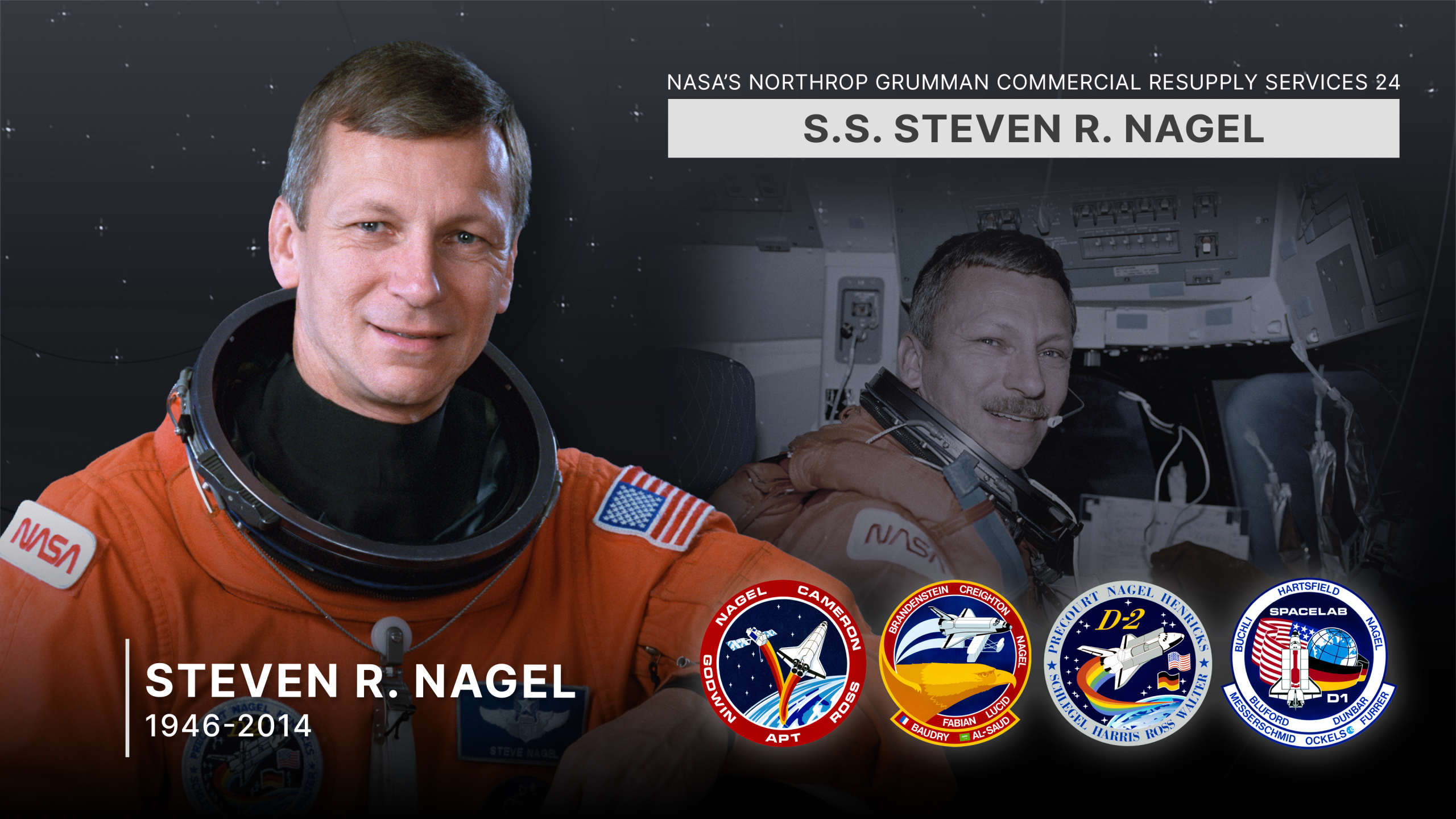
NASA’s Northrop Grumman Commercial Resupply Services 24 mission, or Northrop Grumman CRS-24, will deliver approximately 11,000 pounds of science and supplies to the International Space Station. This mission will be the second flight of the Cygnus XL, the larger, more cargo-capable version of the company’s solar-powered spacecraft.
The Cygnus XL will launch on a SpaceX Falcon 9 rocket from the Cape Canaveral Space Force Station in Florida. Following arrival, astronauts aboard the space station will use the Canadarm2 to grapple Cygnus XL before robotically installing the spacecraft to the Unity module’s Earth-facing port for cargo unloading.
Along with supplies and equipment for the crew, Cygnus XL will deliver a range of scientific investigations to the International Space Station that helps to advance knowledge and technology in support of the Artemis program. This research includes:
A new module for the Cold Atom Lab to expand its research capabilities and improve our understanding of general relativity, planetary composition, and dark matter. The Cold Atom Lab advances quantum research to improve technologies, such as solar cells, MRI scanners, and components that power phones and computers.
An investigation (InSPA-StemCellEX-H2) studying blood stem cell production in microgravity to create a larger number of therapeutic cells. Successful stem cell production could advance healthcare on Earth for patients with certain blood diseases and cancers.
An investigation (Nanoracks-ITSI) that measures how radio signals sent from Earth change as they pass through the upper atmosphere. These measurements could improve models that predict the impacts of solar activity and space weather, which can disrupt technologies like GPS navigation and radar tracking systems.
A study (CBIOMES) of how spaceflight impacts the relationship between organisms and their gut microbiome. Researchers will observe changes in roundworms down to the cellular level to identify ways to maintain microbiome stability and help protect astronaut health on future Moon and Mars missions.
A study (CBIOMES) of how spaceflight impacts the relationship between organisms and their gut microbiome. Researchers will observe changes in roundworms down to the cellular level to identify ways to maintain microbiome stability and help protect astronaut health on future Moon and Mars missions.
- The European Enhanced Exploration Exercise Device is a compact exercise system that help preserve muscle mass and bone health in microgravity. By enabling a broader and more adaptable range of resistance exercises, this device combines cycling, rowing, and resistance training in addition to the ability to perform rope-pulling and climbing movements, even when unpowered. The device was jointly developed by NASA and ESA (European Space Agency).
- The Supplemental Heat Rejection Evaporative Cooler provides heat rejection for the orbiting laboratory in the event of dual thermal control system loop failures. The cooler connects to the vacuum system and multiple onboard water sources to evaporate water through hollow fiber membranes.
- The Ocular Coherence Tomography is a noncontact medical imaging device that uses reflected light to produce detailed cross-sectional and 3D images to actively track the eye during imagery. Tracking eye movement with simultaneous dual-beam imaging minimizes motion artifact, enables noise reduction, and allows the instrument to precisely track changes in crew eye health over time. This unit will replace a degraded unit in orbit
- 8 hatch seal covers, to be installed over current hatch seals
- 2 batteries to support the operations of the Zarya module
- 3 resupply water tanks for the water storage system
- 1 nitrogen tank and 1 oxygen tank, used for recharging spacesuits and maintaining a pressurized environment on space station
- 1 pretreat and water dispenser, a spare unit for the Waste and Hygiene Compartment