
Listen to this audio excerpt from Ryan Schulte, Orion flywheel project manager:
As the four Artemis II astronauts traveled on a 694,481-mile journey around the Moon and back, the Orion spacecraft provided them with all the essentials for deep space life, including daily exercise. The crew used an exercise device called the flywheel throughout their mission to maintain their physical and mental health, and Ryan Schulte, Orion flywheel project manager, led the team responsible for developing the flywheel for the historic flight.
At NASA’s Johnson Space Center in Houston, Schulte oversees the team that designed, built, tested, and flew the flywheel used on Artemis II, and currently develops a fleet of more reusable exercise devices for future Artemis missions.
Ryan Schulte
Orion Flywheel Project Manager
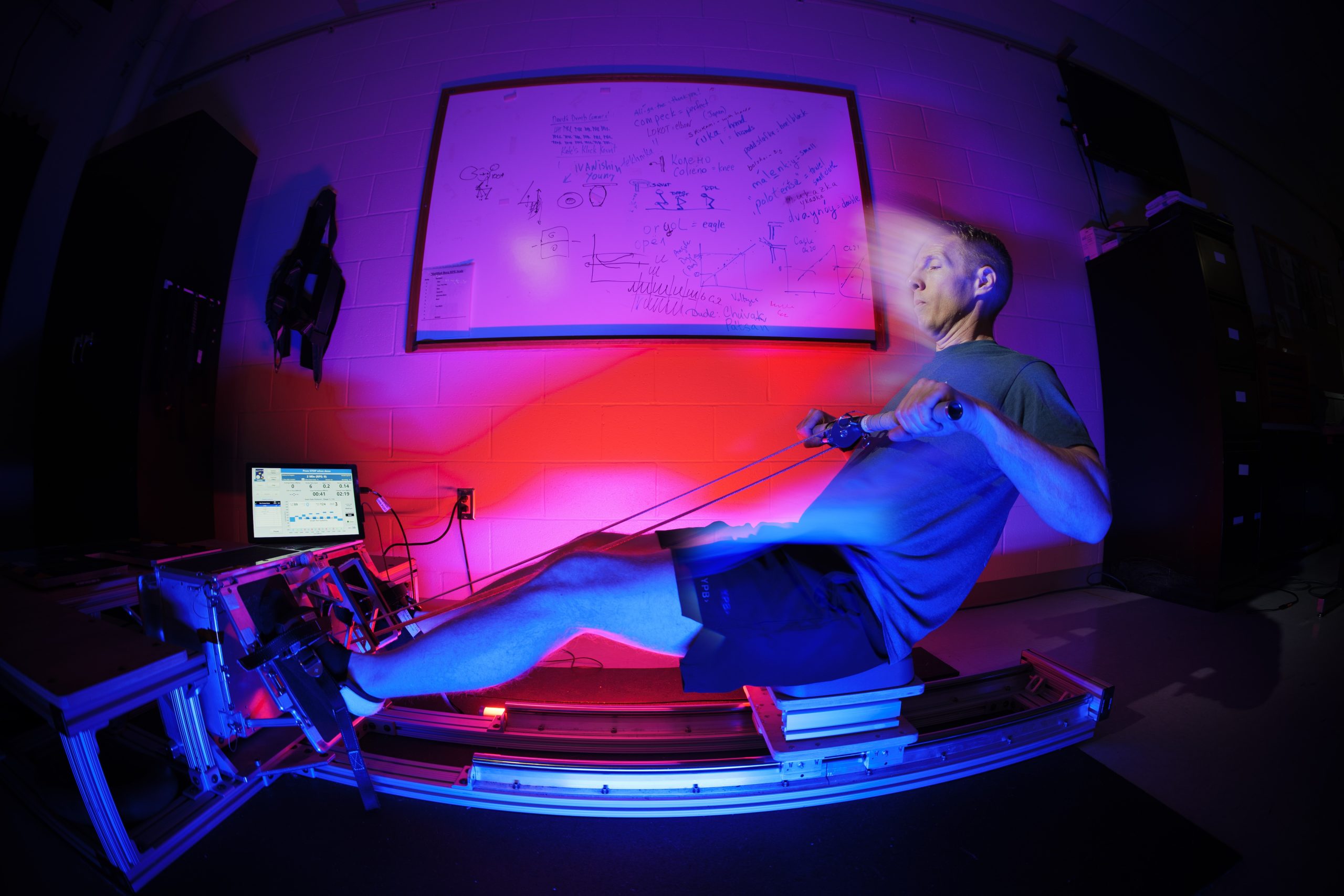
The flywheel is a compact, multi-functional device about the size of a large shoebox that provides the crew with a range of aerobic and resistive workouts without requiring any electrical power from the spacecraft.
“It works kind of like an inertial yo-yo,” said Schulte.
The user can select different gear ratios for different resistance modes, and the flywheel can provide ultimately up to 500 pounds of resistance.
“It’s really all dependent upon how much effort you put in. The crew can do squats, deadlifts, bent rows, high-pulls, curls, heel raises, and aerobic rowing all in one device.”
Developing the flywheel for Orion posed unique challenges for Schulte’s team, ranging from limited space and crew mobility to reducing noise generation for easy crew communication during workouts.
“One of the biggest challenges was trying to fit everything into this compact box, and also to be able to have enough space inside the rest of the capsule for someone to fully stand up and fully extend at high rates of speed and repetitions,” said Schulte.
The team’s successful response to these challenges was displayed during the approximately 10-day Artemis II mission, where the crew members exercised for roughly 30 minutes per day with the flywheel. The sessions helped to counteract both the physical and mental effects induced by a microgravity environment, which on future, longer-duration Artemis missions, will become an increasingly important component for astronauts.
“Without Earth’s gravity, the crew’s muscles, bones, and stamina all begin to atrophy, or weaken,” Schulte said. “Exercise will help prevent injury as crews need to perform long lunar spacewalks on the surface or for emergency egress out of the capsule.”
Exercise with the flywheel also supports the crew’s mental health, providing psychological benefits while living in a compact space inside Orion.
“It’s a great form of stress relief,” Schulte said. “It improves their mental clarity by getting their fluids and their blood flowing, which can stagnate in your head in zero gravity. We’ve talked to some of the crew about how much clearer their minds feel after exercise in flight.”
Schulte began his career as a co-op at Johnson in 2007, then joined NASA full-time as a test engineer for pyrotechnics, propulsion, and power systems. He later transitioned to NASA’s Human Health and Performance Directorate and began working in the Human Research Program, where his interest in human interfaces with engineering grew, eventually leading him to his current role as the flywheel project manager.
With the success of Artemis II and the promise of future missions ahead, Schulte’s work on the flywheel and next generation exercise devices will play a vital role in keeping astronauts safe, healthy, and mission ready on the lunar surface and beyond.

Ryan Schulte
Orion Flywheel Project Manager