
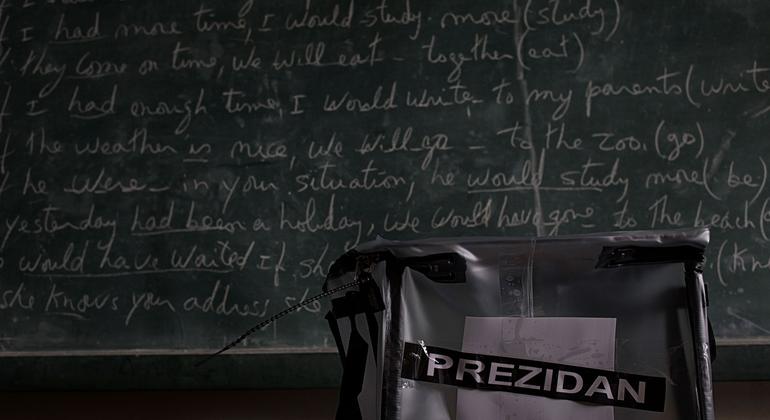
Elections have not been held since a protracted electoral cycle from 2015-2017 which brought the late President Jovenel Moïse to power.
Haiti has not had an elected president since he was assassinated in 2021.
A succession of interim administrations have taken on the responsibility to govern as the country waits to hold elections.
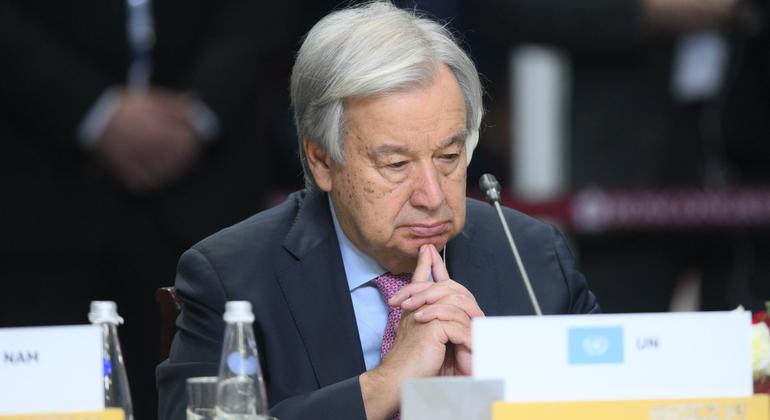
The UN Secretary-General’s Special Representative for Haiti, Carlos Ruiz Massieu, who is based in the capital Port-au-Prince said that the new National Pact for Stability and the Organization of Elections was a “significant political act”.
He added that it met Haitian priorities for “the restoration of security, the organization of credible elections and the re-establishment of democratic governance”.
A burnt out vehicle litters the side of a road in a neighbourhood in the Haitian capital, Port-au-Prince.
Why the political situation matters
A stable government will be essential for improving the daily life of the people of Haiti.
Weak governance and the insecurity that leads to, has enabled armed gangs to expand territorial control, undermine the rule of law, and carry out atrocious human rights abuses.
These have included killings (more than 8,100 were documented in 2025), kidnap for ransom, the recruitment of children and sexual violence with collective rapes of women and girls.
Gang violence has also led to the displacement of an estimated 1.5 million people, many of whom were already suffering from high levels of poverty – a situation which has been exacerbated by economic collapse.
Haiti’s protracted political transition is not an isolated domestic issue but has ramifications for regional stability such as the trafficking of drugs and weapons by gangs and the migration of its citizens overseas.
So when could elections be held?
The UN with the international community has always maintained that any durable political solution needs to be a Haitian-led process.
The authorities are being supported in their efforts to organise and hold municipal, parliamentary and presidential elections. The current Prime Minister Alix Didier Fils-Aimé has reportedly said they will be held by the end of the year.
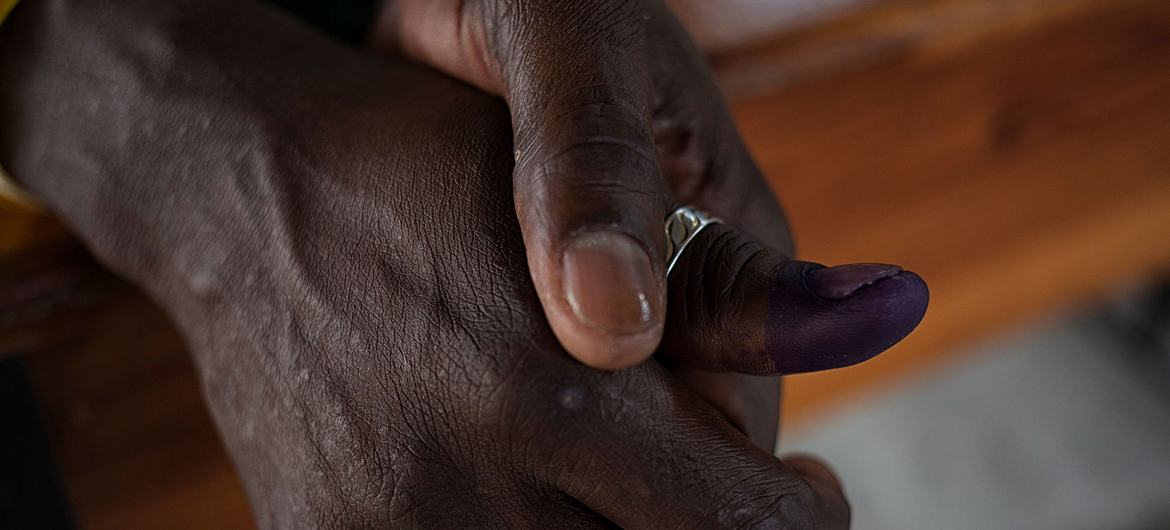
An ink mark on the thumb shows that this voter in Haiti went to the polls in 2016. (file).
What is the international community saying?
The Security Council which is made up of 15 Member States of the UN meets at least four times a year to discuss the situation in Haiti.
In its latest resolution it urged “all Haitian stakeholders to come to an agreement over the future governing structure,” while expressing “deep concern about the lack of progress” in achieving a political transition.
The resolution also notes recent institutional steps, including the 2025 decree establishing specialised judicial bodies to address corruption, gang violence, and sexual crimes, reforms seen as essential to restoring the rule of law and political credibility.
Despite these initiatives, ongoing insecurity, the weakness of Haitian institutions as well as political fragmentation continue to delay progress toward elections and constitutional governance.
What is the role of the United Nations?
The UN is playing a central political and coordinating role through the United Nations Integrated Office in Haiti, often known by its French acronym, BINUH.
The mission is led by Carlos Ruiz Massieu and has a mandate until January 2027. The Security Council stresses that the mission’s “good offices” role is critical for enabling a transparent Haitian-led transition.
BINUH is distinct from, but works alongside:
- UNSOH (the United Nations Support Office in Haiti) mandated to provide logistical, technical and administrative support to the UN-backed and council-mandated Gang Suppression Force (GSF).
UN agencies, like UNDP, UNICEF and the World Food Programme, which provide humanitarian and development assistance
How is the UN responding?
UN support to Haiti’s transition focuses on integrating political assistance with security, justice and human rights initiatives including:
- facilitation of a national dialogue and the constitutional process including ensuring a peaceful transfer of power
- support for justice reform and specialised courts addressing corruption and mass crimes
- assistance to judicial institutions and prison administration
- support for designing a Haitian-led disarmament, dismantlement, and reintegration (DDR) programme
- coordination with international partners to reduce community violence
- monitoring and reporting human rights abuses, including sexual violence
- support to national authorities to strengthen human rights protections
What happens next?
2026 comes with high expectations for the holding of long over-due elections.
An electoral calendar sets the first round of legislative and presidential elections for 20 August and a second round, if necessary, coupled with municipal elections on 6 December.
According to media reports, around 300 political parties or groups have registered to participate in the elections.
To meet these deadlines, progress is needed to stabilise the security environment and create conditions conducive to holding a fair vote.
The UN continues to facilitate dialogue, support elections, strengthen justice institutions and promote accountability, but progress ultimately depends on Haitian stakeholders reaching consensus.
Political differences need to be overcome to improve security, reduce displacement and avoid economic collapse.
A credible political transition is essential for national recovery.