
Their experiences underline a broader message: inclusive economic growth depends on opening space for those too often excluded, including people with disabilities, youth and home-based innovators.
Entrepreneur by necessity
For Shaymaa Saeed, a young Egyptian crochet designer and handicrafts artist with a disability, entrepreneurship was not a lifestyle choice but a necessity. Health challenges prevented her from securing formal work, pushing her to rethink how she could earn a living.
“I started my project from home in 2018 due to health challenges, after I was unable to secure a job,” she told UN News.
Instead of giving up, I turned my hobby into a source of income
What began as a personal coping strategy gradually became a viable business. Ms. Saeed went on to take part in some of Egypt’s largest handicrafts exhibitions, building confidence and visibility along the way.
Recently, she presented her work outside her home country for the first time, marking a significant milestone in her journey.
Stepping on stage
“My participation marks my first step onto the international stage,” she said, pointing to the role of entrepreneurship training and institutional backing. “The support I received helped me grow personally and professionally, with greater confidence.”
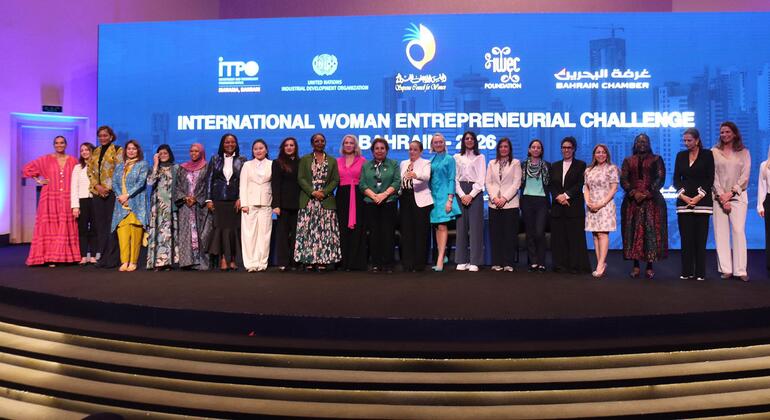
Awards Ceremony for International Woman Entrepreneurial Challenge Bahrain 2026
All the issues raised by Ms. Saeed’s experiences are up for discussion during this week’s Sixth World Entrepreneurs Investment Forum (WEIF), in the Bahraini capital, Manama, where a parallel exhibition on home-based entrepreneurship is showcasing how targeted support can turn personal challenges into economic opportunity.
Organised by the UN Industrial Development Organization’s (UNIDO) International Technology and Innovation Promotion Office in Bahrain, the gathering is bringing together entrepreneurs, policymakers and investors from dozens of countries.
Big dreams
Ms. Saeed’s enterprise remains entirely home-based and online, but her ambitions extend well beyond that. “I do not yet have a physical store, but I dream of having my own space to showcase and sell my work, and of reaching markets across the world as a successful small business.”
Ms. Saeed is candid about the realities of building a business from scratch. “Success does not come overnight,” she said. “It is a continuous journey of effort, learning and development.”
I dream of having my own space to showcase and sell my work, and of reaching markets across the world
Similar themes are emerging from other women using art and entrepreneurship as vehicles for agency and expression.
Bahraini visual artist and art teacher Mariam Sayed Anwar, who also lives with a disability, described creativity as both discipline and emotional release.
“My work moves between still life, portraits, charcoal, pencil and acrylic,” she explained, stressing the importance of experimentation. “I never limit myself to just one medium.”
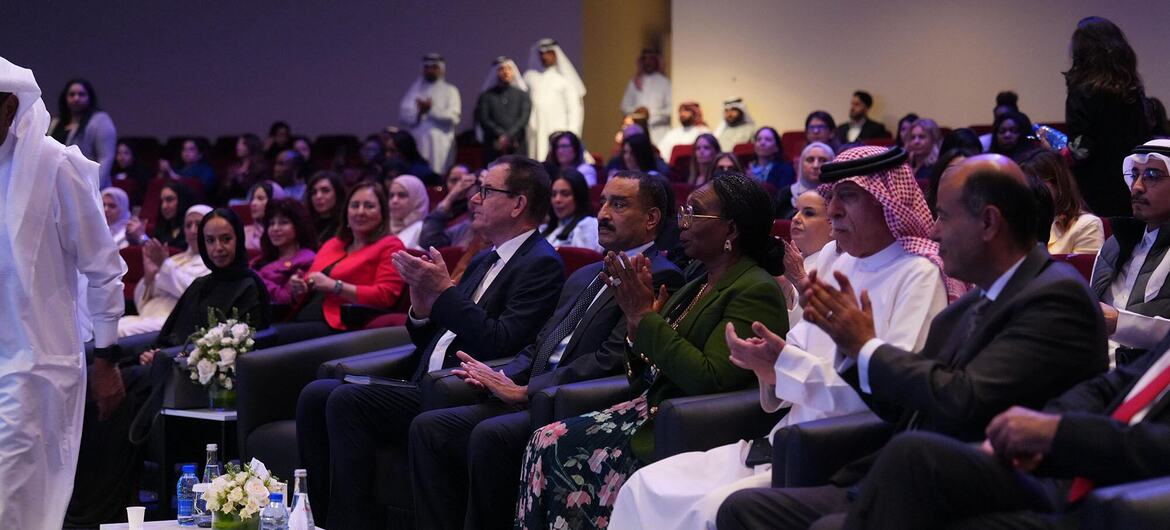
UNIDO Attendees Applaud at WEIF2026 in Bahrain
For her, art communicates what language sometimes cannot. “Through paint and brushes, I can express what is in my heart and soul more than writing ever could. Art is my language; when words fall silent, my work speaks for me.”
International exposure
Beyond individual stories, entrepreneurs from Africa gathering in Bahrain are highlighting the structural conditions that shape success or failure.
Zimbabwean entrepreneur Dr. Roselyn Musaruru-Wacharewa said exposure to international networks had reshaped her understanding of what is possible – not just for individual women, but for entire regions.
“In many African countries, governments tax entrepreneurs so heavily that it feels like they want you out of business,” she said, contrasting this with environments where policy actively encourages enterprise.
Her appeal was blunt: African women entrepreneurs are ready, but governments must “change the narrative and give them real access and recognition”.
Guterres underlines private sector role
The importance of creating such enabling conditions was echoed by UN leaders and national officials, though the emphasis remained on outcomes rather than rhetoric.
In his message delivered in Bahrain on Tuesday, UN Secretary-General António Guterres underlined the private sector’s role as an engine of jobs, innovation and investment, particularly through micro, small and medium-sized enterprises, which account for roughly two-thirds of global employment.
He stressed that growth must go hand in hand with respect for human rights and labour standards, and with expanding opportunities for those left behind.
UNIDO officials highlighted youth and women as central drivers of innovation, while Bahraini authorities pointed to national initiatives supporting young and women entrepreneurs, alongside strategies embracing artificial intelligence and new technologies.
Lived experience
Yet the strongest arguments for inclusive growth came not from policy statements, but from lived experience.
From home-based businesses run entirely online, to art that speaks where words fail, entrepreneurs like Shaymaa Saeed illustrate what becomes possible when talent meets opportunity – and what is lost when barriers remain.