
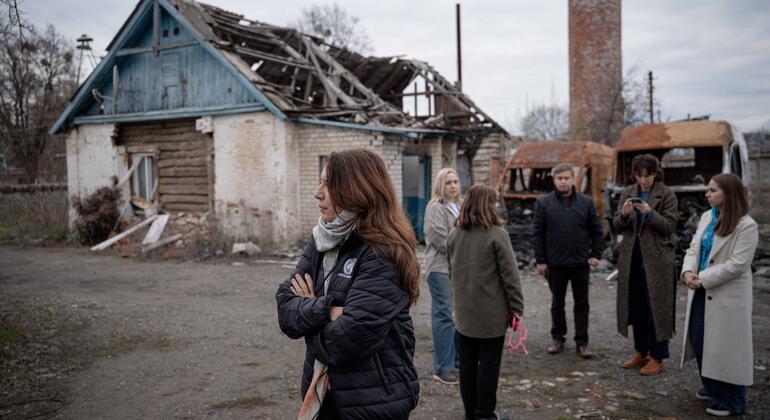
Vanessa Frazier, the UN Secretary-General’s Special Representative for Children and Armed Conflict, has shed light on the devastating consequences of Russia’s invasion of Ukraine for children. Following her visits to Ukraine and the Russian Federation, Frazier emphasized the profound scars left by the conflict on young lives and the critical need for their protection.
Speaking to UN News ahead of the International Day of Innocent Children Victims of Aggression on June 4, Frazier pointed to the disproportionate impact of the war on education. Ukrainian children, already grappling with the shift to online learning post-COVID-19, are now facing the trauma of being unable to attend school safely for an extended period. Frazier shared her personal understanding of the challenges children face with six continuous years of online education. However, she commended the commendable efforts by the Ukrainian government, UNICEF, and NGOs to ensure educational continuity through creative solutions like underground and metro schools.
During her visit to the Russian Federation, Frazier addressed the General Assembly’s resolution concerning the displacement of Ukrainian children and the grave violations against children, specifically the killing and maiming of children and attacks on schools and hospitals, two of the six grave violations by the Russian Armed Forces. She noted that discussions with Russia have been constructive, with progress made on the issue of missing Ukrainian children, though negotiations on commitments are ongoing.
Visiting frontline cities like Belgorod, Frazier underscored that the conflict inflicts casualties on both sides and that the UN applies its framework on the six grave violations impartially. She also touched upon the psychosocial consequences of war, highlighting the uncertainty and trauma experienced by children, particularly in frontline areas. An incident witnessed at a school operating in a Kharkiv metro station vividly illustrated the randomness of war and the fragility of children’s lives. Frazier recounted the story of a 12-year-old girl who narrowly escaped death when her location was hit without warning, noting that hundreds of similar stories exist.
Frazier identified children with disabilities as among the most vulnerable groups affected by the war but praised the accessibility efforts in projects within Ukraine. She also spoke about opportunities for humanitarian cooperation between the two sides, noting that the cultural and familial ties between Belgorod and Kharkiv exacerbate the tragedy of the war. In her concluding remarks, Frazier urged the international community to increase educational support, emphasizing that children should not be forced to choose between safety and education. She concluded by stressing the urgent need for the war to end so that children do not continue to pay the price for decisions made by adults.