
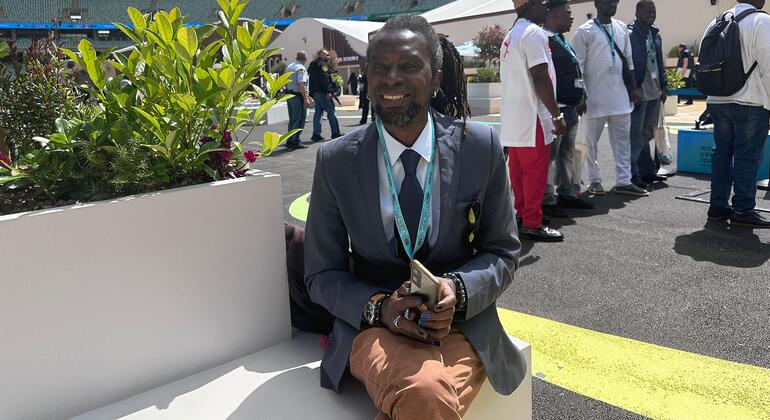
Latyr, a former European Commission employee who once led a stable middle-class life in Belgium, found himself living in a tent on the streets of Spain for four years due to a fraud investigation. Although eventually exonerated, the ordeal turned his life upside down.
Latyr is now sharing his experiences with the public through a documentary titled ‘What Nobody Wants to See’ at the World Urban Forum in Baku, Azerbaijan.
At WUF13, UN-Habitat convened with partners like The Gere Foundation and HOGAR SÍ to place homelessness at the center of the global urban agenda. This platform highlights the magnitude of the homelessness crisis and, simultaneously, the potential to end it.
HOGAR SÍ, an independent non-governmental organization established in 1998, works to end homelessness in Spain. For over 25 years, it has supported more than 10,000 individuals across 11 regions by focusing on housing solutions and advocating for human rights, with Latyr being one of them.
“I had a good life. And I lost it overnight,” Latyr told UN News.
An Unending Journey
Latyr expected to stay in Spain for only three days upon his arrival. At the time, he was in his 40s, living in Belgium, divorced, and had lost his job at the European Commission. He had a family, children, and a “normal life.” But then he made a decision that changed everything.
He was approached by individuals concerning a bank transaction involving what appeared to be a legitimate check. Latyr never touched the document; he only requested it be sent to his bank in Spain. However, by the time the check reached the bank, officials identified it as fraudulent.
Authorities confiscated Latyr’s passport, bank cards, and documents during the investigation, suspecting he might be involved in a larger criminal network. “They told me, ‘You have to stay in Spain. You cannot leave the country until the investigation is over,’” he recounted.
Every month, he was required to appear before a judge and sign papers proving his presence. He could have fled; there were no real border controls preventing his exit to another European country. But he chose not to take the risk.
“I didn’t want to take that risk,” he added calmly.
A Life Under the Trees
Instead, he stayed and slowly spiraled into homelessness. For nearly four years, Latyr lived on the streets, unable to work legally without identification and trying to survive alone in a foreign country.
He found a small community of homeless people living in tents under the trees in a wooded area. Together, they created a fragile version of an ordinary life. “We were well-organized in our spot,” he recalled. “We would buy vegetables, meat, small things to eat. We were trying to build a life.”
To survive, he took on informal jobs in street markets, helping vendors carry crates of fruits and vegetables. Despite having degrees in economics and finance, he could only earn enough money for food and basic necessities. “It was about survival,” he said.
Illness and a Turning Point
Then came illness. Doctors initially diagnosed him with emphysema. Later, he learned he had lung cancer. While Spain provided medical care to those in need, treatment was not straightforward.
“The doctor told me, ‘If I give you chemotherapy while you are living on the street, you will die,’” Latyr recounted. They advised that the treatment was too aggressive and that he needed a safe place to rest, eat well, and take his medication regularly.
That’s when HOGAR SÍ stepped in. The organization placed him in a shelter called ‘Espacio Salut’ (literally, ‘health space’), where he received a bed, meals, and support while undergoing chemotherapy. “It saved my life,” he said. “But it also gave me the opportunity to get off the streets.”
He slowly began to rebuild. Leveraging his background in economics and finance, he started freelancing on his laptop. Former contacts and clients in London, France, and the United States began sending him work remotely.
Even after years, he still struggles to comprehend how quickly an ordinary life can crumble. “Sometimes, when you are down and not very strong mentally, you can make mistakes,” he reflected. “And these mistakes can take you very far from reality.”
“Four Years of My Life Lost”
What pained him most was that after years of investigation, authorities returned his passport and belongings without any explanation. No charges were ever brought against him. “Okay, take your passport back, take your laptop back,” he recalled. “That was it.”
By then, four years of his life were lost.
Today, Latyr speaks publicly about homelessness through the documentary ‘What Nobody Wants to See.’ His message at the World Urban Forum was directed not only at governments but also at the business community and housing developers.
A Crisis That Can Be Solved
He believes homelessness can be solved. According to him, there are about 37,000 people living on the streets in Spain, a number he finds manageable for a country of 50 million.
“If they want to stop it now, they have the means,” he stated. He points to partnerships between NGOs and private real estate companies that are already exploring affordable housing initiatives for vulnerable individuals.
“There is really something that can be done,” he said. “We just need to think about the right business model and connect all these organizations together.”
For Latyr, homelessness is not just about lacking a roof over one’s head. It is about losing one’s dignity, identity, and connection to society through a chain of events that can often begin much faster than people imagine.
UN News is covering the Summit from Baku throughout the week. You can follow it here.