

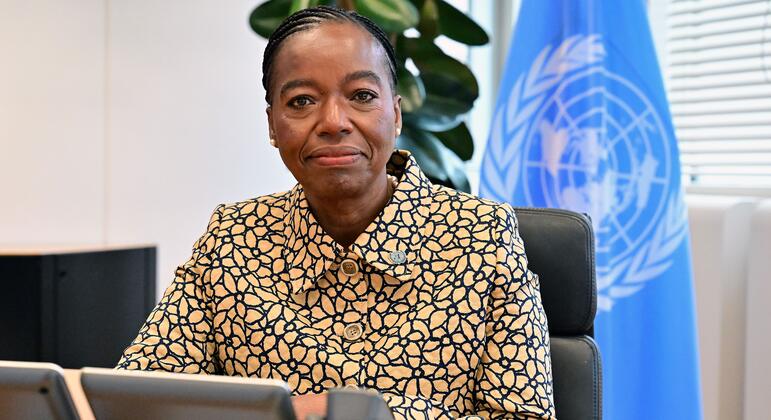
Monica Juma, the new Executive Director of the United Nations Office on Drugs and Crime (UNODC) and Director-General of the United Nations Office at Vienna, has emphasized the critical need for strengthened international cooperation to combat increasingly complex and interconnected global threats. Juma highlighted that as criminal networks become more sophisticated and intertwined, global collaboration is not only necessary but has also become adaptive.
Juma urged for more robust partnerships to tackle international organized crime, corruption, terrorism, human trafficking, and technology-enabled threats. Drawing on her extensive background in public service in Kenya, with experience in defense, security, foreign relations, and multilateral cooperation, she aims to support countries in their fight against these pervasive issues. Her overarching goal is to ensure “security, protection, and justice for all.”
Upon her oath of office administered by UN Secretary-General António Guterres, Juma expressed her honor in assuming the role during such a pivotal time. She underscored the value of “cross-institutional cooperation” in addressing complex challenges, leveraging her broad expertise in security, diplomacy, and governance. Juma stressed the importance of building consensus among member states, noting that UNODC’s mandate is highly relevant to the current risk portfolio facing the world.
“The understanding that no single sector, country, or region can achieve this alone” serves as a cornerstone for enhanced international cooperation and multilateralism, Juma stated. She expressed optimism fueled by the competence of UNODC staff, yet acknowledged that the rapid evolution of threats tempers this optimism. Juma pointed out the increasing convergence of transnational, cross-sectoral, and technology-driven criminal networks, necessitating similarly interconnected responses.
Addressing the operational challenges, Juma noted that voluntary and often restricted funding impacts UNODC’s work and encouraged donors to provide more flexible support. She looks forward to the upcoming UN Crime Congress in Abu Dhabi in September, which she believes will help shape the response to this changing landscape and provide a framework for future cooperation among member states.
Juma also touched upon the rapid advancement of technology, noting that innovation often outpaces governance. She called for closer collaboration between governments and industry to bridge this gap. The emergence of new criminal forms, such as AI-powered human trafficking, was highlighted, with Juma expressing a desire for concrete commitments, not just discussions, at the Abu Dhabi conference.
Reflecting on her appointment, Juma recognized its symbolic significance, particularly for young people and women in Kenya and East Africa, who feel pride and hope. She reiterated UNODC’s commitment to increasing its impact and prioritizing global justice, protection, and human dignity.