
Born from the melting pot of American society in the late 19th century, jazz has evolved into a powerful force for social change, challenging racial discrimination, promoting equality, and fostering cultural understanding.
In the 21st century, jazz continues to resonate as a vehicle for social commentary and activism. Three-time Grammy-winning jazz pianist Sullivan Fortner highlighted this enduring relevance in an interview with UN News at the Village Vanguard, a renowned jazz club in New York, ahead of International Jazz Day on April 30.
“Jazz means freedom. Jazz means America. Jazz means humanity. Jazz means love,” Fortner stated, adding, “As long as artists continue to produce, it will always be relevant to the times we live in.”
The annual celebration of jazz underscores its role as a universal language of freedom, creativity, and peace. It offers an opportunity to appreciate not only the music itself but also its potential to contribute to building more inclusive societies.
Before his performance at the Village Vanguard, Fortner reflected, “It’s all about the emotional transfer, and transmitting those emotions to each other. Jazz is 100 percent that, everything good, bad, and ugly together.”
This iconic venue, claiming to be the world’s oldest continuously operating jazz club, located in the heart of Greenwich Village, stands as a testament to the profound legacy of this often-underestimated art form.
From Poets to Trumpets
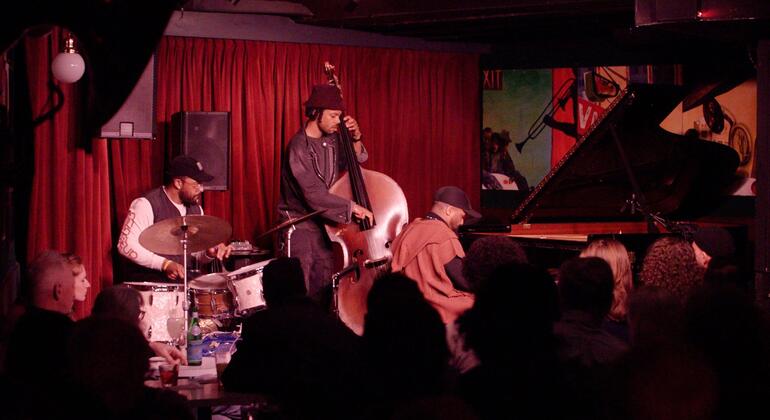
Stepping through the red doors of the Village Vanguard and descending the narrow stairs leads visitors into a distinctive triangular room with a low ceiling that has remained largely unchanged for decades, evoking a sense of jazz’s rich history.
The stage is set with a large upright bass, a Steinway piano, and a simple drum kit. In front of them, patrons seated at vintage tables and chairs are framed by a colorful mural on the back wall, adorned with portraits of legendary artists like Miles Davis and John Coltrane.
Deborah Gordon, the club’s owner, shared, “We try to keep everything very simple here.”
However, when the Sullivan Fortner Trio takes the stage, the atmosphere transforms from nostalgic to vibrantly alive as the group launches into improvisation, inviting the audience into a realm of unpredictable musical exploration.
Unity Through Jazz
Gordon noted that the Village Vanguard has hosted a diverse array of artists throughout its history, including poets, dancers, and folk singers, serving as a platform for “all kinds of cultural and political events.” She explained that by 1957, jazz became the sole musical genre featured, deemed the most effective way to fulfill this platform’s purpose.
Gordon added that, aside from a brief period after World War II when jazz entered the mainstream, it has “always been marginal, appealing to a specific audience.”
“There are a lot of old people like me and a lot of young people like you, a big mix of people,” Gordon observed.
Melodies and Messages
As Sullivan Fortner and his trio continue their performance, an underlying current of emotion flows through the room, woven between the melodies.
“There’s an energy from the music, from the stage, to the people. And back… it’s a circular thing… you can really feel the unifying power that music can bring,” Gordon remarked.
Evolution and Revolution
This unifying power enabled jazz to become a tool for empowerment and social change for marginalized Black communities in New Orleans, where the music originated.
Fortner explained, “The way the music started, it was pure protest… we were born out of a rebellion where we artists tried to make a statement.”
Later, artists like Billie Holiday used jazz to protest racial injustice and promote integration, with the music becoming a soundtrack to the Civil Rights Movement in the United States.
Gordon pointed out that jazz continues to evolve today, “always incorporating different music from different places.”
Fortner added, “Jazz is beyond notes and rhythms. It’s language. It’s the way people talk. It’s the way they gesture to each other.”
While jazz embraces new instruments and forms of expression, its capacity for social commentary and activism remains intact.
We must remember that this is street music, and it should be accessible to everyone, even those without shoes.
Never Forget the Streets
Reflecting on jazz’s current place in culture, Gordon stated, “It’s still a bit of a fringe music in the culture. And I’m okay with that, because to me, that’s why it will last. It won’t just flare up and disappear. It’s solid. And within that solidity, it changes and evolves.”
Although many now view jazz as a high art form akin to classical music, musicians emphasize the importance of remembering its roots.
Fortner cautioned, “Sometimes we’ve gotten so intellectually deep that we’ve forgotten to reach out and bring the streets with us. We can’t forget that it was born in the streets, in the brothels.”
He further emphasized, “We must remember that this is street music, and it should be accessible to everyone, even those without shoes.”
“We have to remember that and carry those people with us, no matter when we perform or what we play.”