
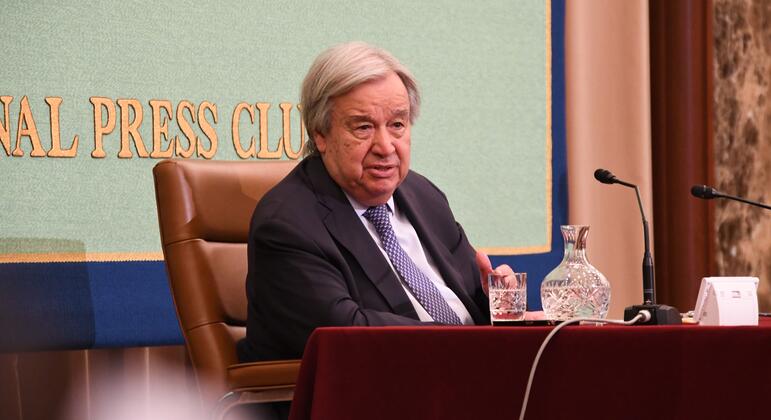
United Nations Secretary-General António Guterres, speaking on the final day of his official visit to Japan, highlighted the importance of partnership in a world grappling with “conflicts, climate chaos, and inequalities.” During a press conference celebrating 70 years of cooperation between Japan and the UN, Guterres noted that rising inflation and deepening cost-of-living crises are exacerbated by current unrest in the Middle East, which has sent prices for commodities like energy and fertilizers soaring.
Guterres emphasized the need for the immediate restoration of freedom of navigation in the Strait of Hormuz and for “ending all violations of the ceasefire and creating the conditions for a political solution to the conflict.” He stated that mistrust and geopolitical divisions are hindering effective solutions, adding that countries are violating international law with impunity. Military spending now surpasses development aid, and funding cuts have devastating consequences for the world’s most vulnerable populations.
Security Council Reform Deemed Essential
In his broad assessment, Guterres reiterated his long-standing call for the reform of outdated international institutions. “The global governance architecture – in particular the UN Security Council and global financial institutions – is not as effective as it needs to be at this challenging moment,” he said. He stressed that the reform of the UN Security Council is of paramount importance.
“A Question of Legitimacy”
Addressing the Council’s structure, which includes five permanent members with veto power (China, France, the UK, the US, and Russia) and 10 non-permanent members elected for two-year terms, Guterres called for an increase in the number of permanent members. He pointed out that Asia, representing half of the world’s population, has only one representative, while Africa and Latin America have none. “This is a serious question of legitimacy and effectiveness, and it is absolutely necessary to increase the number of permanent members and non-permanent members for the Security Council to correspond to today’s world, to the realities of today’s world,” Guterres stated.
Guterres also underscored the need for a “more equitable multilateral system that can continue to defend international law and hold countries accountable to it.” He described the UN as an “indispensable, unique meeting point to advance peace, sustainable development, and human rights,” but noted that the Organization is only as strong as the commitment of its Member States.
A “Bad Example”
When asked if international institutions like the UN can prevent conflicts, the Secretary-General responded, “it is not multilateralism that is in crisis.” Guterres pointed to the behavior of “superpowers that violate international law, sometimes create conflicts themselves, and use their veto power in the Security Council to guarantee their impunity.” He explained that this makes it extremely difficult for the UN Secretariat to control the dramatic increase in conflicts worldwide. This happens, he noted, because “when there is a bad example from superpowers, it is natural that other medium-sized powers around the world think that they can do whatever they want with impunity.” He drew attention to situations in the Democratic Republic of Congo, Sudan, and the Horn of Africa. The Secretary-General reiterated the importance of Security Council reform, stating, “We now have a set of powers that are constantly intervening externally within countries in conflict, and this makes our capacity to prevent conflicts and to mediate extremely difficult.”