

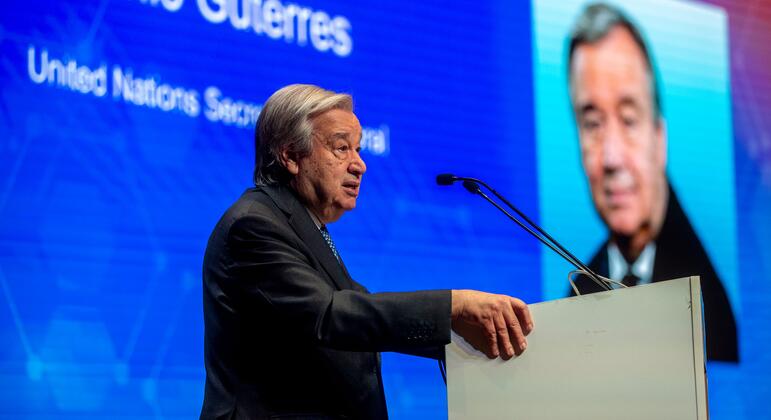
United Nations Secretary-General António Guterres stated that artificial intelligence (AI), guided by science, can become a reliable engine for achieving Sustainable Development Goals (SDGs). Guterres urged the international community to build a future where policies are as intelligent as technology’s capacity to drive them.
New Expert Panel Established
The Secretary-General emphasized that AI innovation is advancing at lightning speed, surpassing collective abilities to fully understand or even govern it. “If we want AI to serve humanity, policy cannot be predictive,” Guterres stated, highlighting the need for reliable and shareable information across countries and sectors. In response, the UN is developing mechanisms that place science at the center of international AI cooperation. To this end, an Independent International Scientific Panel on AI, comprising 40 leading experts in the field, has been appointed.
The panel aims to bridge the “AI knowledge gap” and assess the real-world impacts of new technologies on economies and societies. This will enable countries to act with the same clarity, regardless of their AI capacity levels.
Accelerating Progress, Anticipating Risks
Guterres explained that the panel will provide a common analytical foundation to help member states move from philosophical debates to technical coordination, grounding choices in evidence. He stressed that science-based AI governance is an accelerator for solutions, not a brake on progress. Guterres added that this approach will help determine where AI can benefit most and fastest, making progress safer, fairer, and more broadly shared. He also noted that the international community can anticipate AI impacts early, such as risks in areas like children or labor markets, allowing countries to prepare, protect people, and invest.
Dangers of Fragmentation
Guterres pointed to the current tense environment of mistrust and increasing technological competition, which complicates international cooperation. Without a common foundation, fragmentation is inevitable, leading different regions to operate with incompatible policies and technical standards. This, he warned, would increase costs, weaken security, and deepen divides. The Secretary-General suggested that countries can align their technical foundations under the guidance of UN initiatives like the Independent Panel and the Global AI Governance Dialogue, scheduled for Geneva in May.
Meaningful Human Oversight
Guterres argued that while science provides knowledge, human control over AI must be a technical reality, not just a slogan. He stressed the need for meaningful human oversight in all high-risk decisions, such as those affecting justice, health, or credit, and for clear accountability, ensuring responsibility is never delegated to an algorithm. He emphasized that people must understand how decisions are made, be able to question them, and receive answers.