
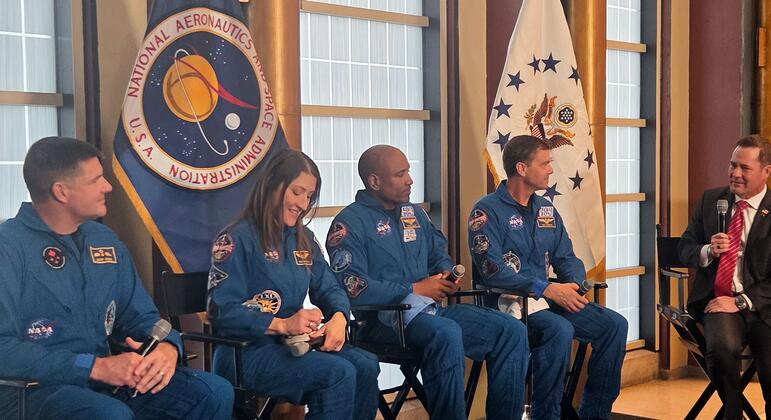
The visit of the Artemis II astronauts to the United Nations (UN) continued a tradition of speaking on peace, international cooperation, and our shared global future. The four-person crew recently completed the farthest human spaceflight in history, venturing beyond the far side of the Moon and returning to Earth after a demanding 10-day mission. During this brief period, they have reignited a shared sense of humanity in space exploration.
Tradition and Continuity
The UN General Assembly Hall has long hosted pioneers of the space age. The 1963 visit by Soviet cosmonauts Yuri Gagarin and Valentina Tereshkova symbolized not only technological advancement but also the idea that space could be a unifying force for humanity. Since then, representatives from numerous countries have addressed the international community to emphasize that space exploration is impossible without cooperation and shared responsibility.
The Artemis II mission carries on this legacy. The mission represents not just a technological leap but an international partnership model that includes the European Space Agency and scientific instruments developed by experts from around the globe. At an event hosted by U.S. Ambassador Mike Waltz, the astronauts stated that their mission was not merely to test a spacecraft, but also to remind humanity of what can be achieved when we work together.
From Deep Space to Earth
For all astronauts, one of the most profound experiences was seeing Earth from deep space. From hundreds of thousands of miles away, the planet appeared small, fragile, and almost weightless against the vast darkness. Pilot Victor Glover expressed gratitude for what they saw and where they would return. Astronaut Christina Koch described an abrupt realization about the scale of humanity in the boundless universe. Koch stated, “You realize that it’s not absolute or guaranteed, and that there actually is a global scale… that scale is our world, and what we do with it is our choice.”
Life Aboard the Spacecraft
Life aboard the spacecraft was demanding. The crew had to balance experiments, navigation, system monitoring, and constant adaptation to microgravity. Canadian astronaut Jeremy Hansen shared a humorous anecdote about eating a granola bar: “One day, I was opening a granola bar. Victor was floating next to me, and when I ripped the package, everything just flew out really fast and went everywhere in the spacecraft, and it stuck to Victor’s shirt. And he said, ‘Oh, don’t worry, I got it,’ and he grabbed a spoon and started eating it off his shirt.”
Returning to the Moon
Artemis II is just the beginning of a larger endeavor. The program aims to return humans to the Moon, establish a sustainable presence on the surface, and construct infrastructure, including a lunar base, to support long-term exploration. These plans are underpinned by the Artemis Accords, a set of international principles endorsed by dozens of countries. Speaking from the UN platform, the astronauts encouraged young people not to be afraid to ask questions and to listen carefully to the answers. Ultimately, the crew emphasized that Artemis II is not measured solely by distance or technological achievement. Space offers a perspective that allows us to see Earth as it is: a unique, shared, fragile, and unifying place. Reid Wiseman concluded, “Everyone asks what the Earth looks like from space, and most of the time I answer, the tiny Earth is an amazing place.”