
As Iran’s actions disrupted approximately 20% of global oil trade and led to the stranding of around 20,000 sailors in the Persian Gulf, the United Nations Secretary-General called for an urgent ceasefire. Beneath these geopolitical tensions, marine life continued its existence.
Returning to the Sea
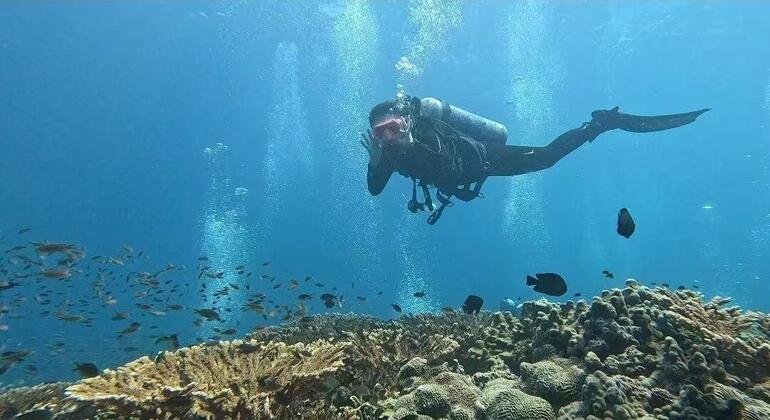
Three Chinese divers based in the UAE—diving instructor Rui Li, freediver Shanshan Du, and technical diver Jie Zhang—had been unable to dive for weeks due to coastal closures. When a limited ceasefire in mid-April allowed for restricted access, they immediately returned to the water.
This year’s World Oceans Day on June 8, themed ‘Reimagining Our Connection Between People and the Ocean,’ held particular significance for these divers. For Du, who dived on April 18 in the narrowest part of the strait between the UAE and Oman, just days after the UN announced Iran would keep the strait open for commercial vessels during the ceasefire, the return was emotional.
“We were a little worried before we set out,” Du said. “But after more than two months, being able to dive again was wonderful for all of us. We encountered a large pod of dolphins. There were no signs of the war I imagined; there was only peace and beauty before my eyes.”
Zhang, who dived in the region last week, described a diversity of corals rarely seen elsewhere, with soft and hard corals varying by topography, and numerous sea turtles resembling a nature reserve.
Worrying Signs Emerge
However, Zhang also observed more troubling signs. “I saw more white debris on the seabed than I had before,” he noted, uncertain of its origin. While following dolphins, he observed the water around the animals clouded with green algae, oil slicks, and floating trash.
“I remember when I used to chase dolphins, the water was blue. It is still very heartbreaking to see this scene with my own eyes,” he added.
Li acknowledged both realities. He pointed out that while the strait may not be the world’s most biodiverse marine region, its complex topography supports an unusual diversity of coral reefs—formations ranging from “white as silver needles” to colonies “purple as pine forests”—alongside seahorses, whale sharks, and rare species.
He recounted a story of a boat captain, unable to dive and with no other means of communication, who could reliably find a pod of dolphins that recognized him. “We would greet each other and then part ways,” Li said. “This is truly a magical place.”
Potential Catastrophe
Yet, the potential impact of armed conflict on such a location is not lost on them. Li stressed that an attack on oil storage facilities could be catastrophic for marine life. “Many marine creatures are small and vulnerable. A single attack could be enough to wipe out some magnificent species that humans have never even seen.”
Zhang articulated the fragility of the underwater world. “Nobody can speak for the underwater ecosystem—fish cannot speak, nor can the large animals.
“We are throwing all the disputes, wars, and pollution on land into the ocean, ignoring that the ocean does not have a strong self-preservation ability and can only endure all the conflicts and damage caused by human activities.”
Diving quietly removed some certainties for the three. “Underwater, there are no borders for the ocean,” Zhang stated. “Ocean currents and schools of fish move freely. Whale sharks roam, following fixed routes between different countries—they are free. Humanity should share this blue world instead of tearing it apart with disputes.”
The Mother Ocean
Li offered a warmer, perhaps more honest, metaphor for the boundaries of human action. He likened the relationship between humans and the sea to that of a child and a parent: the ocean nourishes us, helps us grow, and occasionally disciplines us.
“We have reached the age where we want to protect it, but what we can do is still limited,” he said. “Our parents are still quietly waiting for us, helping us, and continuing to nourish us.”
Du, diving in a location where people from dozens of nationalities converge, realized underwater that borders felt meaningless. Communication occurred solely through gestures. “Through this hobby, and thanks to the ocean, a wonderful environment has been created for us.”
On the surface, the ongoing conflicts have not ended. Negotiations between Washington and Tehran remain fragile, and conditions are volatile. However, with 71% of the Earth being ocean, Li’s message is clear: “Come and feel the refreshing water whenever possible.”