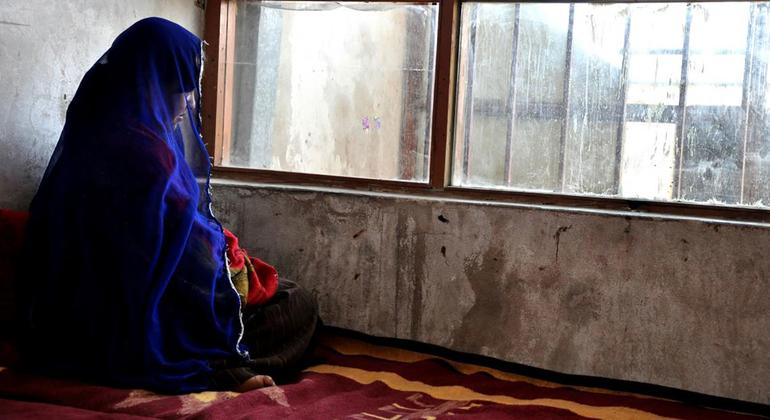

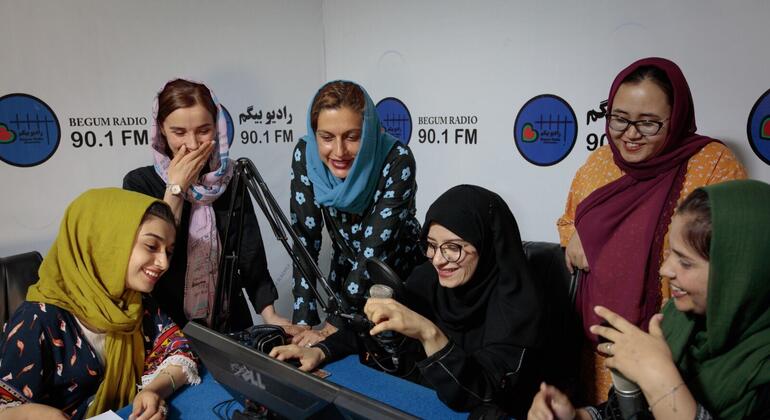
Radio Begum continues to be a vital voice for women in Afghanistan, broadcasting despite challenging conditions within the country. Station founder Hamida Aman highlights the difficulties women face in accessing public transportation, particularly young women, and describes how female journalists gather at the studio to prepare for and conduct live broadcasts.
‘A Glimmer in the Darkness’
Supported by the United Nations Educational, Scientific and Cultural Organization (UNESCO), the station operates with approximately 30 female employees. Radio Begum broadcasts across a significant portion of Afghanistan, excluding about a dozen provinces where authorities have banned women’s voices from the media.
Aman observed, “Currently, when you change the TV channel or switch between radio stations in Afghanistan, you only hear male voices or see images of men.” In this male-dominated soundscape, Radio Begum stands out.
“To hear a woman’s voice in an entirely male universe is like a small light, a glimmer in a dark ocean.”
A Radio Station For Women, By Women
Radio Begum began broadcasting in March 2021, just a few months before the Taliban returned to power. The station’s founder, Aman, was born in Kabul but moved to Switzerland with her family at age eight to escape conflict, where she pursued journalism studies. She returned to Afghanistan to work for Afghan media after the fall of the Taliban regime in 2001.
In its early days, the station emphasized the achievements of Afghan women over the past two decades, airing music, entertainment programs, and interviews with active women. “Radio Begum is a radio station made for women, by women.”
However, following the Taliban’s takeover in August 2021, media outlets had to rapidly adapt their content. Aman stated, “We had to remove music from the air overnight. We had to pull our entertainment programs overnight.”
Navigating New Restrictions
Over the following months, restrictions on women and the media intensified. Women became increasingly excluded from many public roles, and female journalists had to work under strict conditions: they could only interview women and could not be alone in the same studio with a man.
Aman recalled, “There were constant warnings and threats.” To continue broadcasting, the station opted to avoid any political conflict. “We decided not to engage in politics. That is one of the reasons we are able to continue working.”
In late 2024, a decree issued by Taliban officials declared it “inappropriate” for women’s voices to be heard in public spaces, leading many provinces to ban female voices on radio and television.
Aman explained, “We are a radio station serving women. We are no longer a regular media outlet.” In this context, Radio Begum gradually adapted its programming, shifting its focus to education. “We were pioneers in using our airwaves for education.”
Long before the widespread ban on girls attending school, the station began broadcasting lessons in the fall of 2021. This mission became central when schools were later closed to young girls. “They closed the schools, yes. School is banned, but education is not. So we will bring school into the home as much as possible.”
Today, a six-hour educational program based on the Afghan school curriculum airs daily, with three hours in Dari and three hours in Pashto. The station also broadcasts programs on social issues, including health, psychological support, medical advice, religious guidance, women’s entrepreneurship, and addiction. Most are broadcast live, allowing listeners to call in and ask questions.
Promoting Women’s Rights Through Islam
Radio Begum has adopted an unexpected approach to discussing women’s rights: religious texts. Aman stated, “We inform women about their rights, and we use Islam to do it because that is the only way,” adding that the station’s religious programs draw on verses, surahs, and hadiths from the Quran, broadcast by female theologians.
“Islam is very clear about the place of women in society,” Aman said, relaying rules concerning inheritance, divorce, the status of widows, and education. “We quote verses, surahs… so they cannot say anything.” Officials initially reviewed the presenters’ understanding of religious texts, but their reaction surprised the editorial team. “They told us it was their favorite program.” Today, the program is among the station’s most-listened-to shows.
‘My Husband Behaves Much Better’
Each program receives numerous calls from listeners nationwide. “The calls from listeners are a very good indicator of the impact of our programs.” Due to demand, some programs, particularly those focusing on psychological support, have been extended. A listener from Bamyan province reported learning about her inheritance rights through a program and being able to advocate for them within her family. In another instance, a woman explained that listening to a show had changed her husband’s behavior. “My husband listened to the program, and since then, he behaves much better and much kinder.”
These testimonies, as Aman puts it, “encourage us and give us some comfort.”
‘We Have to Intervene’
Despite these small gains, the reality remains harsh. “Being an Afghan woman means many restrictions and many concerns,” Aman said. In this context, Radio Begum aims to provide a rare space for expression and listening. “We are responding to the needs that the government should be providing for women, but since this government has decided to ignore 50 percent of its population, we have to intervene.” In a country where women are increasingly barred from public life, Radio Begum continues to broadcast, offering a rare space where women can still be heard.