
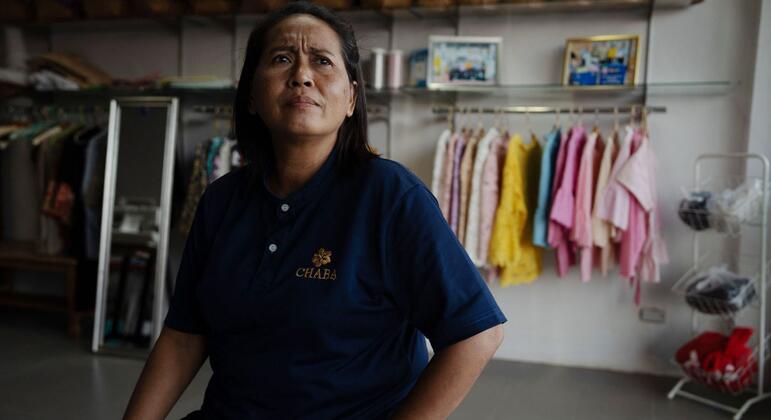
Mariyam Tadein was sentenced to death at the age of 21. Police discovered over half a million pills of ‘yaba,’ an illegal drug mixture of methamphetamine and caffeine common in Southeast Asia, in a rented house in southern Thailand.
Tadein recounted her experience: “I spent 20 years, five months, and 15 days in prison. I was sentenced to death, alongside someone who was executed by lethal injection. I knew I was next, that I would die. There were enough yaba pills in that house to fill a truck. They weren’t mine, but that didn’t matter. I went to prison, and everything happened so fast: I was charged with drug trafficking and sentenced to death. I was ready to die then,” she said.
Marked for Death Row
For the subsequent two years, she was forced to constantly wear a sign that read “Death Row.” She faced death for eight years. However, she accepted it after undergoing a special training course on how to prepare for dying during her final two years. That same year, a major flood occurred, and she was transferred to another prison. There, she was informed that a royal pardon for death row inmates had been granted. Her Nigerian friends also received pardons. There were nine of them, and they celebrated by making a cake.
Mariyam Tadein shows a video of her entire village welcoming her after her release from prison.
While relieved to have survived, Tadein felt as if she were already dead, knowing she would spend the rest of her life incarcerated. She decided to focus on something to occupy her time. She learned sewing in prison classes and then began working. The more she worked, the more meaning she found, focusing on the patterns of fabric and thread. “Thread by thread. Every day.” She also earned privileges, such as showering after sunset, in a prison shared with over 4,000 women. Life became easier. The most challenging period for her was her transfer to Songkhla Prison in southern Thailand. The other inmates were extremely poor.
Inmates participate in a sewing training session at a prison in southern Thailand.
This was difficult for her because, at one point, her family stopped visiting, assuming she would remain in prison forever. What was the point of visiting? Her husband moved on and remarried. Learning this was incredibly hard. She took pride in her ability to focus on her work, concentrating on different patterns. She wouldn’t allow herself to dwell on her story, what led her to prison, or her husband’s new life. She couldn’t change it; it had happened. She had to move forward. When negative thoughts arose, she would return to the fabric, back to the pattern.
Patterns of Life and Death
Everything shifted during the 2004 tsunami. She was tasked with sewing fabric bags for bodies. With so much death, she was cutting a lot of fabric. This served as a distraction from her own life. “I would focus on the pattern.”
In 2021, Mariyam was released from prison at the age of 52, having received a second royal pardon for good behavior. An owner of a sewing business, who had previously trained inmates, offered her a job. Today, at 56, she is working, sewing, and living with her children and her reunited husband.
The United Nations Office on Drugs and Crime (UNODC) has facilitated access to practical skills like carpentry and sewing by providing vocational training equipment to approximately 60 prisons in Thailand, thereby enhancing opportunities for inmates both during and after their incarceration.