
Facing an existential threat from rising sea levels, the Pacific island nation of Tuvalu is implementing innovative strategies to preserve its sovereignty and culture. In a significant move, the Tuvaluan government established the world’s first ‘digital nation’ in the metaverse in 2022, as a contingency against the potential loss of its physical territory. This initiative precedes a proposed visa program with Australia, under which over 90% of Tuvalu’s population is expected to apply for residency or citizenship by 2025.
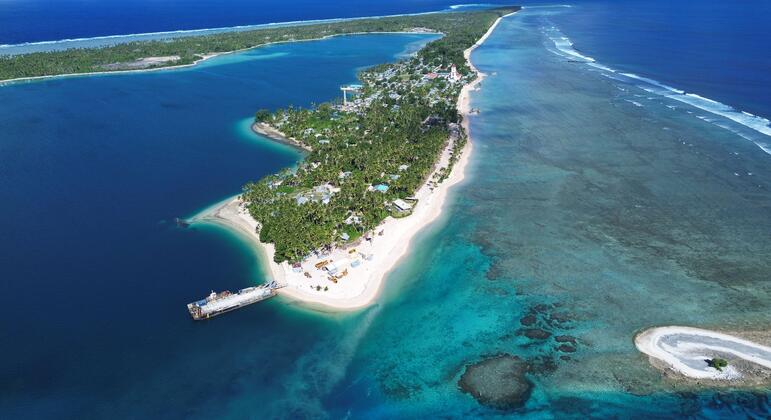
For this small, isolated community of a few thousand inhabitants, the resources to combat the escalating impacts of climate change are severely limited. The nation’s low elevation, with much of its landmass lying less than two meters above sea level, makes it exceptionally vulnerable.
Children play in a coastal area protected by sandbags on the island of Tuvalu in the Pacific Ocean.
Tuya Altangerel, a Senior Officer at UNDP in the Pacific, emphasized the critical situation to UN News: “People often say, ‘You’re talking about thousands of people, six thousand people.’ But for us, these 6,000 people are on the front line of the climate crisis, and we owe it to them to protect their livelihoods and not disrupt their daily lives.”
With support from the UNDP, the government is intensifying efforts to safeguard Tuvalu, focusing on protecting its most populated islands.
Minor Sea Level Rises, Devastating Consequences
Sea level rise, a direct consequence of global warming, occurs as ocean water expands when heated and glacial ice melts. The Pacific Ocean is experiencing some of the fastest rates of sea level rise globally, exacerbated by ocean currents and wind patterns that create a ‘pile-up’ effect on vulnerable low-lying islands.
Workers prepare for coastal protection efforts on the atoll of Funafuti in Tuvalu.
In Tuvalu, sea levels have risen by 21 centimeters over the past 30 years, nearly double the global average. Projections indicate that without significant intervention, up to 95% of the country could be submerged by 2100.
The Growing Threat of King Tides
A primary daily challenge for island communities is the increased frequency and intensity of king tides. “Our islands are drowning,” Altangerel stated.
Traditional coastal defense methods, such as building sea walls or planting mangroves, are proving insufficient as the sea encroaches. Mangroves risk being submerged, and king tides can easily breach even substantial sea walls.
“It’s not just about the loss of coastal areas, but also about the sense of nationhood of the people and the future existence of these countries.” — Tuya Altangerel
Migration as a Solution?
While adaptation projects are underway, migration is also a viable option. The 2023 Falepili Union agreement between Tuvalu and Australia allows for 280 Tuvaluan citizens to resettle or gain citizenship in Australia annually. Last year, 90% of the nation’s population applied for the associated ballot.
Similar agreements exist for other Pacific nations, with Australia offering visa pathways for workers from Kiribati and Vanuatu. New Zealand provides 75 residency visas annually to citizens of Kiribati and Vanuatu, while the United States has an agreement with the Marshall Islands allowing its citizens visa-free living, working, and studying in the U.S.
These migration pathways raise concerns about the impact on the culture and heritage of Pacific peoples, particularly those with traditional livelihoods.
Can a Nation Survive Without Land?
The physical disappearance of some island nations due to rising sea levels is a distinct possibility. Altangerel warned, “It’s not just about the loss of coastal areas, but also about the sense of nationhood of the people and the future existence of these countries.”
A young child walks through a village square experiencing widespread flooding after a storm. (file)
A 2025 International Court of Justice advisory opinion clarified that physical land loss due to sea level rise does not automatically lead to the loss of statehood or sovereignty. This ruling ensures that Tuvalu can remain a nation-state with its rights and UN representation, even if its islands become submerged.
A Template in Tuvalu
In 2017, the UNDP, in collaboration with the Tuvaluan Government and the Green Climate Fund, initiated an innovative adaptation plan. Utilizing detailed sensor mapping, the project aims to create over seven hectares of new land designed to remain above projected sea levels beyond 2100. The Tuvalu Coastal Adaptation Project (TCAP) involves dredging sand to create elevated land protected against storm surges on the islands of Funafuti, Nanumea, and Nanumaga.
Before (top) and after (bottom) land reclamation efforts under the Tuvalu Coastal Adaptation Project.
“These are very large measures,” Altangerel noted regarding the project, which has cost approximately $55 million to date. “We are rebuilding the land around the atolls so that there is a safe space for people to build shelters and housing.” The second phase, beginning in 2024, will create an additional 60 hectares of land on Fongafale, the island of the capital, Funafuti, where 60% of the nation’s population resides. Many Tuvaluans from less protected outer islands have already migrated here seeking safety.
The government and UNDP are also providing insurance for floods, with the first 400 households in Funafuti set to receive automatic payouts of up to $1,500 for each king tide event. Tuvalu, along with Kiribati and the Marshall Islands, are among the world’s lowest-lying nations. The measures implemented in Tuvalu could serve as a template for future adaptation and survival strategies in similar at-risk regions.
Altangerel stated, “If we succeed in protecting Tuvalu as a nation, we are contributing to scaling and replicating this incredible work in the Pacific and other small island developing states.”
Saving the Pacific, Saving the World
UN Secretary-General Antonio Guterres remarked seven years ago, during a visit to the Pacific islands, “If we save the Pacific, we save the world.”
As the world observes Earth Day on April 22, the efforts in Tuvalu extend beyond mere adaptation; they represent a fight for survival and a crucial test of whether a nation can retain its land, identity, and future amidst the relentless rise of the oceans. The Australian and New Zealand governments are supporting conservation projects in Tuvalu.