
UN Raises Alarms on North Korea’s Military Developments
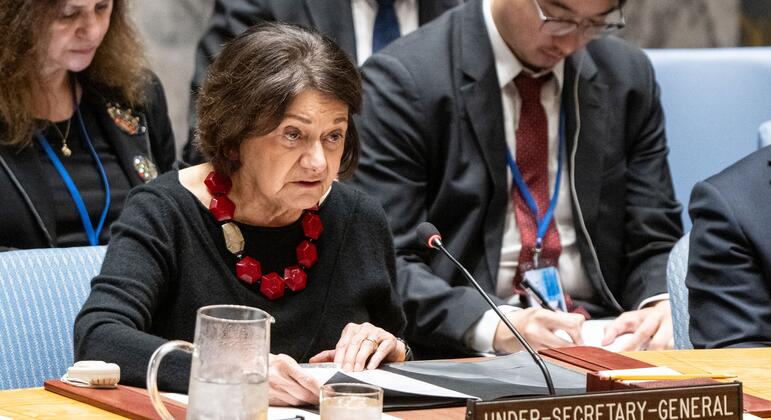
Rosemary DiCarlo, the UN Under-Secretary-General for Political and Peacebuilding Affairs, has expressed serious concern to the Security Council regarding North Korea’s (DPRK) new five-year military development plan launched this year, which violates numerous Security Council resolutions. DiCarlo stated that Pyongyang’s strategy to develop ‘covert new arsenals’ challenges global nuclear disarmament efforts, including the Nuclear Non-Proliferation Treaty.
‘New Arsenals’ and Sanctions Under Scrutiny
The Security Council’s Resolution 1718 (2006) established targeted sanctions against North Korea, including an arms embargo. However, international support for these sanctions has become questionable following Russia’s veto of a Security Council decision aimed at extending the mandate of an independent UN panel monitoring sanctions. DiCarlo urged North Korea to ‘fully comply with its international obligations’ and reiterated the Secretary-General’s calls for the international community to ‘respect the relevant Security Council sanctions in their dealings with the DPRK.’
Concerns Over Ongoing Militarization
In light of the five-year plan approved in February, DiCarlo highlighted that DPRK leader Kim Jong Un has reaffirmed the country’s commitment to ‘further advancing its nuclear and ballistic missile capabilities.’ She emphasized that the DPRK has continued ballistic missile tests through early 2025 and 2026, including short-range missiles, multiple rocket launchers, long-range strategic cruise missiles, and anti-ship missiles. Rafael Grossi, Director General of the International Atomic Energy Agency (IAEA), had previously warned of a ‘very serious increase’ in the DPRK’s fissile material production capacity at the Yongbyon nuclear site. DiCarlo stressed, ‘At this critical juncture, it is essential to underscore the urgent need to reduce nuclear risks, prevent any use of nuclear weapons, and ensure their complete elimination.’
Sanctions Violations and Rising Tensions
Further evidence presented at the council meeting by James Byrne, CEO of the Center for Advanced Defense Studies, indicated growing concerns about violations of sanctions by some international member states. High-resolution satellite imagery revealed that vessels continue to load prohibited cargo in North Korea, creating an ‘open pattern of activity’ that violates Resolutions 2371 (2017) and 2397 (2017). Byrne stated, ‘These are not isolated incidents. It is an ongoing pattern of violation of UN sanctions.’ The overall security environment on the Korean Peninsula remains tense due to increased military activities, coupled with ‘limited avenues for Korean and regional dialogue and growing concerns about the potential for miscalculation.’ DiCarlo concluded, ‘The only way to durably reduce tensions and address these concerns is to ensure sustainable peace and the complete and verifiable denuclearization of the Korean Peninsula. Dialogue and diplomacy are indispensable to achieve this goal.’