
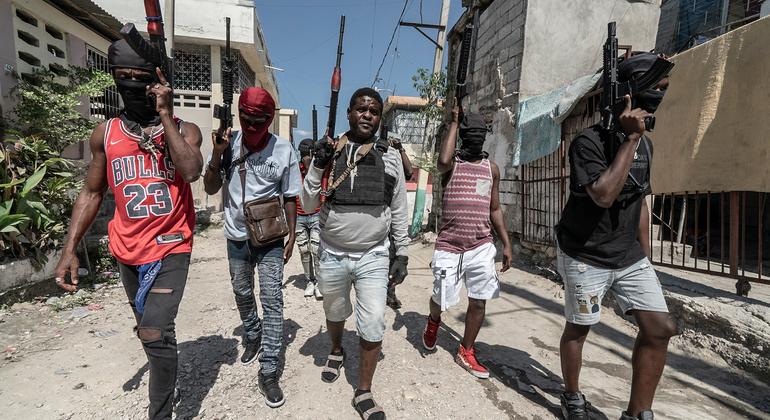
At least 26 gangs operating in and around Haiti’s capital, Port-au-Prince, are perpetrating alarming levels of violence, displacing approximately 1.4 million people and causing thousands of deaths.
A new UN human rights office report, released Tuesday in Geneva, details the impact of escalating gang influence on Haitians’ human rights. As violence continues to claim over 5,500 lives last year, gangs have expanded their operations beyond the capital into the Artibonite and Centre regions. The report indicates that gangs maintain their financial and operational resilience by controlling critical sea and land routes.
Gangs are instilling terror by targeting individuals perceived as cooperating with police or challenging their authority. According to the report, some victims have been executed, with their bodies burned after being doused in gasoline.
Role of Security Forces and Violence
Violence is not solely perpetrated by gangs; Haitian security forces, private security guards, and self-defense groups are also involved. The report identifies approximately 250 instances of “actual or attempted arbitrary executions” by police against suspected gang members or individuals believed to support gangs, using “unnecessary or excessive force.”
Furthermore, security operations conducted by a private military company, reportedly contracted by the Haitian government, are a cause for concern. These operations have reportedly involved drone strikes and helicopter fire, raising questions about their legality. The report suggests that some, or many, of these operations could be characterized as “targeted killings” involving predetermined and intentional use of lethal force, with no apparent investigation by judicial authorities into their legality.
Self-defense groups and mobs, armed with machetes, clubs, and increasingly high-caliber firearms, engage in acts of “popular justice,” leading to the lynching of individuals suspected of gang affiliation. Some of these lynchings are noted as being “allegedly encouraged, supported or facilitated by police elements.”
UN Support for Stability
The UN consistently emphasizes that establishing security is essential for restoring stability in Haiti, but it is not sufficient on its own. Without progress in governance, justice, accountability, and social services, particularly for youth, any security gains are expected to be fragile.
Sustainable international support is critical to break the cycle of violence and instability and to bolster Haitian-led security restoration efforts. The UN-backed Gang Suppression Force (GSF), established in 2025 with a planned strength of 5,000 personnel, is expected to play a key support role. In early March, Daniela Kroslak from Germany was appointed to head the newly established United Nations Support Office in Haiti (UNSOH), which will provide logistical support to the GSF.