
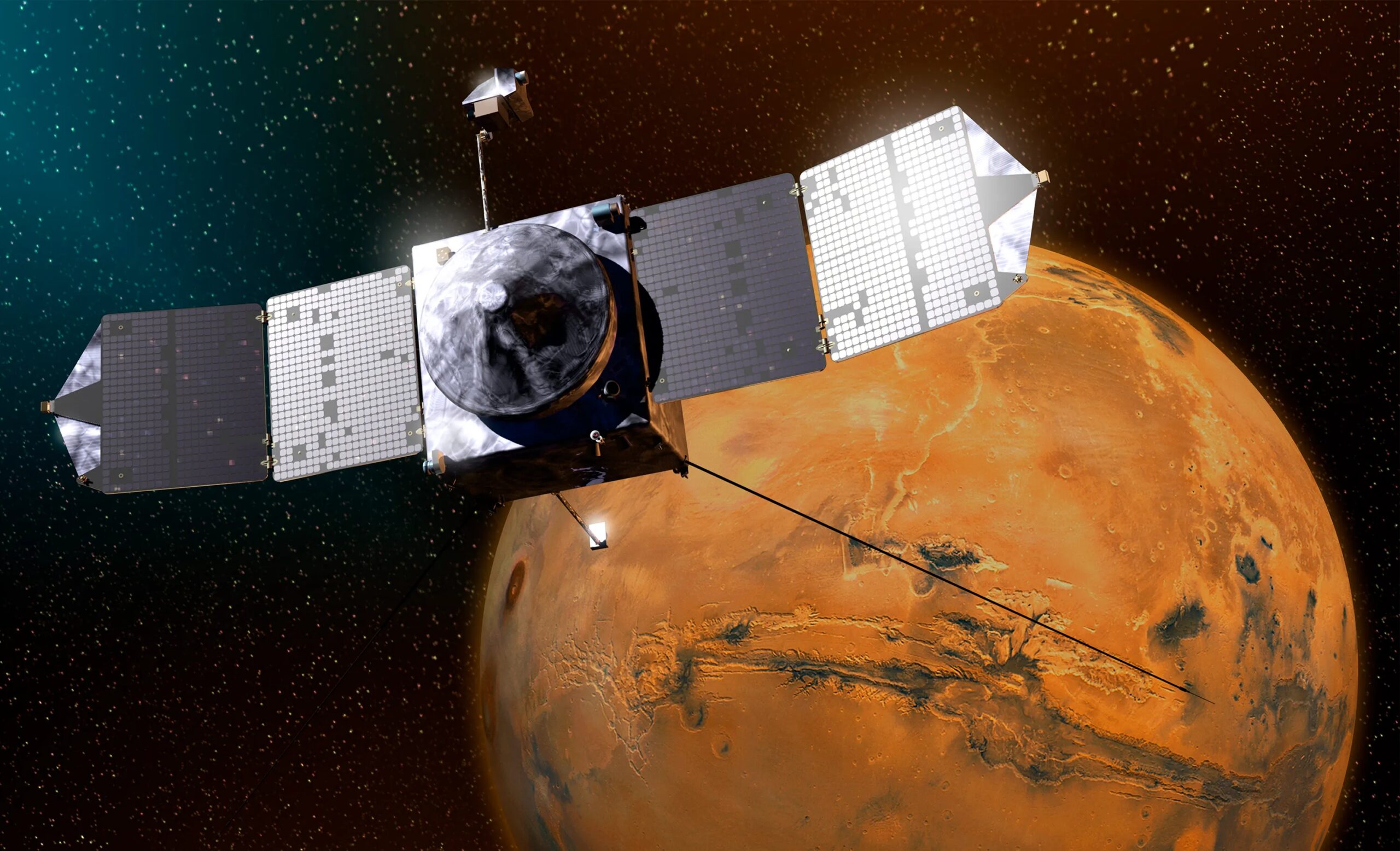
NASA’s MAVEN (Mars Atmosphere and Volatile Evolution) mission, the first spacecraft dedicated to studying the Martian atmosphere and its evolution, has officially ended after more than 11 years in orbit around Mars. The mission’s primary one-year mission was extended for over a decade. The spacecraft experienced an unexpected loss of signal on December 6 as it passed behind the Red Planet.
NASA will hold a media teleconference today, Wednesday, June 3, at 2:00 PM EDT to discuss the achievements of the MAVEN mission.
In February, the agency convened an anomaly investigation board to assess recovery efforts and determine the spacecraft’s current status. The board concluded that the MAVEN spacecraft was unrecoverable and unable to perform its science and data-transmission mission, a finding consistent with the mission team’s observations.
Telemetry data prior to the spacecraft’s December transit behind Mars indicated all subsystems were functioning normally. After the spacecraft emerged from behind Mars, NASA’s Deep Space Network (DSN) did not observe a signal. A brief piece of telemetry data, derived from an analysis of radio signals recorded by the DSN’s open-loop receivers, indicated the spacecraft was in safe mode and spinning at an unusually high rate upon exiting Mars. This suggested an interruption in MAVEN’s orbital trajectory. The investigation board determined that the spacecraft’s batteries were depleted due to this spin, causing its communication system to lose power and rendering MAVEN unrecoverable.
These preliminary findings do not address a potential root cause for the anomaly, which remains under investigation. The investigation board is expected to present its final report later this year. NASA has initiated the formal deactivation process for the MAVEN mission, following standard procedures to archive the entire mission data set for the science and exploration communities.
“The science that MAVEN has provided is foundational for the radiation protection and safety measures we need to take before sending humans to Mars,” said Louise Prockter, director of the Planetary Science Division at NASA Headquarters. “The data collected from MAVEN will continue to provide valuable insights about Mars for decades to come.”
Launched in November 2013, the MAVEN mission studied the Red Planet’s upper atmosphere, ionosphere, and interactions with the Sun to investigate the loss of its atmosphere to space. Understanding atmospheric loss provides scientists with insights into the planet’s atmospheric and climate history, its liquid water, and its potential for habitability.
“The MAVEN mission has truly advanced our understanding of the Martian atmosphere and its evolution. This data set has had a tremendous impact on the field,” said Shannon Curry, MAVEN’s principal investigator and researcher at the Laboratory for Atmospheric and Space Physics at the University of Colorado Boulder. “Our science team is extremely proud of all these incredible discoveries.”
Sun’s Impact on Mars
One of MAVEN’s first major findings was that atmospheric stripping on Mars significantly increases during solar storms. The team studied how the solar wind, a continuous stream of charged particles flowing from the Sun, and solar storms, continuously strip away the Martian atmosphere. They examined how this process may have played a key role in transforming Mars’ climate from a potentially habitable world to the cold, dry planet it is today. The MAVEN mission made unprecedented advances in understanding how the Sun and space weather affect Mars, as it was the only spacecraft capable of measuring both the Sun’s response and the Martian atmosphere’s response simultaneously.
Light Shows on Mars
The MAVEN mission discovered various types of auroras that occur when energetic particles dive into the atmosphere and cause gases to glow by bombarding them. The MAVEN team showed that protons create new types of auroras on Mars. While proton auroras on Earth occur only in very small regions near the poles, they can be seen everywhere on Mars.
Mars’ Atmosphere Escaping to Space
To better understand how Mars lost most of its atmosphere, MAVEN measured atmospheric escape for the first time on any planet. The team measured argon, a noble gas that rarely reacts with other atmospheric components. The only significant removal pathway is atmospheric escape, a process where energetic particles hit gas molecules at sufficiently high speeds, scattering gas molecules out of the atmosphere, similar to a splash from a dive into a pool. Using 11 years of data, the team revealed the presence of scattered argon at high altitudes in the exact locations where energetic particles hit the atmosphere, demonstrating atmospheric escape in real time.
Understanding Mars’ Dusty Secrets
In 2018, a series of dust storms created a massive cloud of dust that enveloped the Red Planet. The MAVEN team studied how this “global” dust storm affected Mars’ upper atmosphere and how these events influence water escape to space. It confirmed that warming caused by dust storms can carry water molecules much higher than usual, leading to a sudden increase in the amount of water lost to space.
Chasing Comets
In addition to Mars science, MAVEN contributed to NASA’s efforts to observe Comet 3I/ATLAS on Mars. For 10 days last year, the MAVEN team designed a new observation campaign, taking multiple images of the comet in multiple wavelengths, similar to using different filters on a camera. It then took high-resolution UV images to identify hydrogen from the comet. By studying a combination of these images, scientists can identify various molecules and better understand the comet’s composition and history.
Throughout the mission’s lifespan, MAVEN’s science team produced over 800 publications, with additional publications planned.
In addition to science, the MAVEN spacecraft played a vital role in NASA’s Mars Relay Network, transmitting data from Mars rovers back to Earth. It also holds the solar system record for the most data transmitted from another planet in a single day.
An audio stream of today’s media teleconference will be broadcast on the agency’s website at: https://www.nasa.gov/live
Media participating in the teleconference by phone are asked to RSVP to [email protected] no later than 12:00 PM. NASA’s media accreditation policy is available online.
The MAVEN mission is part of NASA’s Mars Exploration Program portfolio. The mission’s principal investigator is based at the Laboratory for Atmospheric and Space Physics at the University of Colorado Boulder, which also manages science operations and public outreach and communications. NASA’s Goddard Space Flight Center in Greenbelt, Maryland, manages the MAVEN mission. Lockheed Martin Space built the spacecraft and is responsible for mission operations. NASA’s Jet Propulsion Laboratory in Southern California provides navigation and Deep Space Network support.
For more information about NASA’s Mars Exploration Program, visit:
https://science.nasa.gov/planetary-science/programs/mars-exploration