
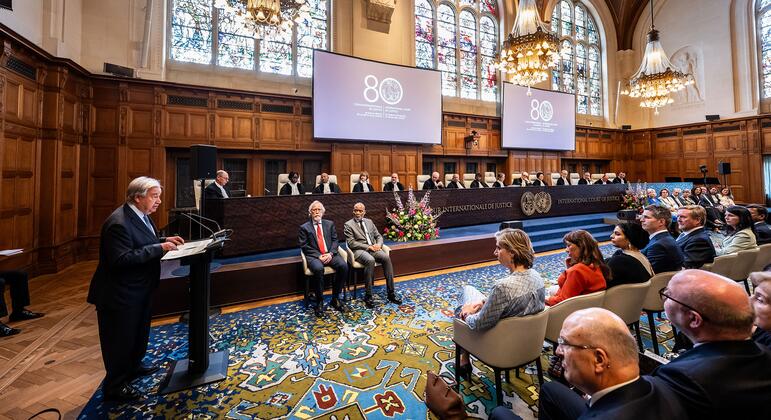
The International Court of Justice (ICJ), the principal judicial organ of the United Nations, resolves disputes submitted by states and provides advisory opinions on legal questions referred by UN organs and specialized agencies. Known as the “world court,” the ICJ is located at the Peace Palace in The Hague.
Speaking from the Dutch city, UN Secretary-General António Guterres reflected on the court’s establishment in the aftermath of World War II.
Justice as a Cornerstone of Peace
Guterres stated that world leaders, at a “dark and difficult moment” he described, “rejected a future governed by force and violence” in favor of one based on the UN Charter and international law. He emphasized that leaders established the Court with a “single underlying belief: that the rule of law, not the rule of the strongest, must always prevail.” This move, he noted, laid “the cornerstone of a more peaceful world,” going beyond merely creating the UN’s main judicial body.
Justice Amidst Trust and Respect
Over the past eight decades, the ICJ’s judgments and advisory opinions have shaped the modern world, the Secretary-General observed, adding that the increasing number of cases before the Court is a “clear sign of trust in its authority and independence.” He also highlighted efforts to modernize the Court’s working methods and increase gender representation among judges as indicators of progress. Guterres stressed that the Court “continues to guarantee that sovereignty and equality are not just words on paper, and that even overwhelming power cannot and must not replace legal obligation.” He clarified that the Court’s decisions, including provisional measures, are binding and that respecting them is not optional but a requirement under the UN Charter.
Threat of Erosion of International Law
However, the Secretary-General warned that this rules-based system is under strain. “Violations of international law are happening before our eyes. Military operations are trampling the fundamental rules governing conflicts. Humanitarian obligations are being ignored,” Guterres stated. He further noted that the rules of international law protecting the UN are being violated, and the ICJ, along with other justice institutions, is increasingly being questioned and challenged. “This erosion is happening not on the fringes of the international system, but at its very center; even by the States entrusted with upholding international peace and security,” Guterres said, warning of the consequences. “When the law of the jungle replaces the jungle of law, instability becomes contagious. Conflicts spill across borders. Economic shocks ripple around the world. And the most vulnerable always suffer first and worst.”
Making the Right Choice
The Secretary-General remarked that the international community is now facing “its own moment of crisis,” with a choice between the rule of law and brute force, arguing that the choice is clear. “It is precisely because the international system is so strained that adherence to international law is more important than ever – particularly in an age of shifting power dynamics,” he said. Guterres urged countries to strengthen international law, recommit to peaceful dispute resolution, respect ICJ rulings, follow advisory opinions, and uphold the UN Charter. “At this moment of crisis, that is the only right choice. Let us have the courage to make it.”