
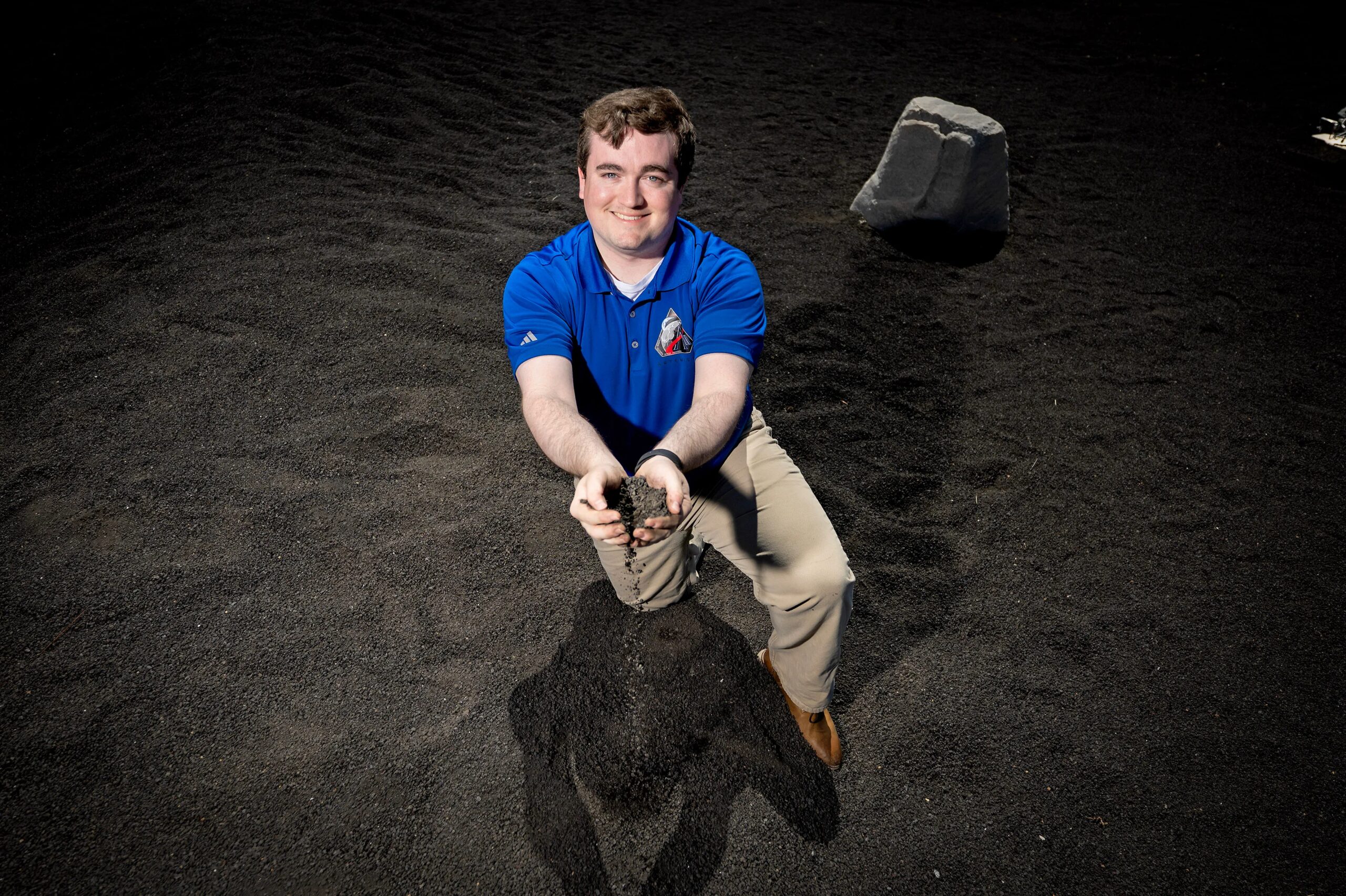
NASA’s Artemis program faces potential challenges from lunar dust and regolith interactions for its human landing systems. Daniel Stubbs, a space engineer at NASA’s Marshall Space Flight Center, is developing models of how rocket exhaust interacts with the lunar soil to ensure crew safety and the success of Artemis missions.
Stubbs pursued his undergraduate, master’s, and doctoral degrees in aerospace engineering at Auburn University with the goal of working at NASA. During his master’s studies, he conducted modeling work on rocket exhaust-surface interactions as part of a project under NASA’s Early Stage Innovations program. These efforts have formed the foundation for his current research supporting the Artemis missions.
During NASA’s Apollo missions, the risks posed by lunar regolith (lunar soil) to astronauts, spacecraft, and equipment became apparent. Regolith, formed over billions of years by meteor and micrometeoroid impacts, contains sharp and abrasive particles. Future lunar explorers and vehicles will encounter similar challenges. The new landing systems under development are larger, heavier, and possess more rocket engines compared to the Apollo Lunar Modules. Furthermore, unlike the Apollo missions, these new systems will utilize their descent engines for ascent. Therefore, accurately predicting the interaction of rocket exhaust with lunar soil during descent is critical for the lander’s survival in this environment and for the safe return of astronauts to Earth via the Orion spacecraft in lunar orbit.
“Dust and regolith clouds that can obscure the view of instruments on the landers can lead to erroneous data being fed into the guidance computers during landing. This can negatively impact the lunar landing. Additionally, when lifting off from the surface to return astronauts to Earth, the lunar soil kicked up by rocket exhaust can damage scientific instruments or other assets deployed on the surface,” Stubbs explained.
NASA’s Human Landing Systems program is conducting extensive ground-based research into the interaction between rocket exhaust and lunar dust and regolith. Tests at NASA’s Langley Research Center, utilizing a 60-meter-long vacuum chamber, will simulate the conditions anticipated for lunar landing systems on the Moon.
These studies will assist engineers in understanding the aerodynamic forces the landers will experience during descent and ascent, heating on the vehicle’s base, and the potential for the vehicle to tip over due to crater formation or surface instability.
Following the landing of American astronauts on the Moon in 2028, Daniel Stubbs will have the opportunity to see the results of his work modeling the lunar dust and regolith clouds generated by rocket engines.
Through the Artemis program, NASA aims to send astronauts to the Moon, laying the groundwork for scientific discovery, economic benefits, and future human missions to Mars.
For more information on NASA’s human landing systems, visit: https://www.nasa.gov/humans-in-space/human-landing-system/